
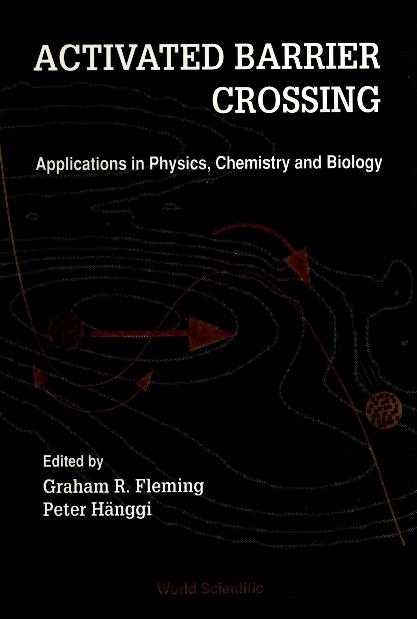
The passage of a system from one minimum energy state to another via a potential energy barrier provides a model for the microscopic description of a wide range of physical, chemical and biological phenomena. Examples include diffusion of atoms in solids or on surfaces, flux transitions in superconducting quantum interference devices (SQUIDs), isomerization reactions in solution, electron transfer processes, and ligand binding in proteins. In general, both tunneling and thermally activated barrier crossing may be involved in determining the rate. This book surveys key experiments chosen from physics, chemistry and biology, and describes theoretical methods appropriate for both classical and quantum barrier crossing. A major feature of the book is the attempt to integrate the experimental and theoretical work in one volume.
Pay easily by card, Klarna, Apple Pay or Google Pay. Not happy? You always have a 14-day money-back guarantee. Read more in our terms. If you have any questions, email us at hello@memmo.org.
Memmo makes studying easier – wherever you are in the world. We bring your course books and smart study tools together in one place: summaries, quizzes, podcasts and flashcards. Plus Ted, your study buddy who answers anything you wonder. Over 50,000 students already study here – built to help you learn faster and stress less.
You might also like
Buy the book0