
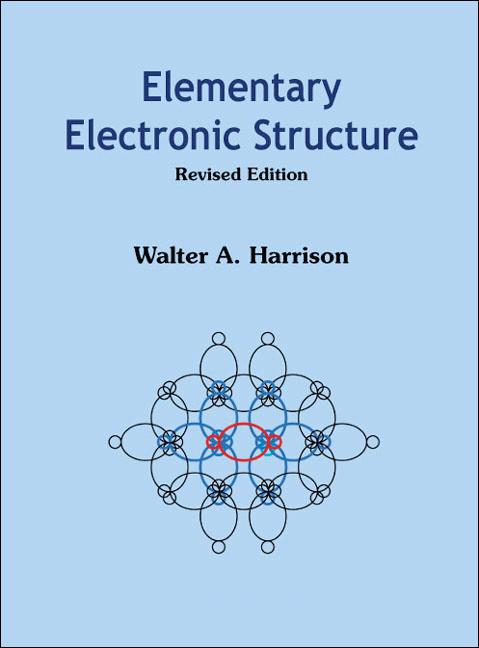
This is a revised edition of the 1999 text on the electronic structure and properties of solids, similar in spirit to the well-known 1980 text Electronic Structure and the Properties of Solids. The revisions include an added chapter on glasses, and rewritten sections on spin–orbit coupling, magnetic alloys, and actinides. The text covers covalent semiconductors, ionic insulators, simple metals, and transition-metal and f-shell-metal systems. It focuses on the most important aspects of each system, making what approximations are necessary in order to proceed analytically and obtain formulae for the properties. Such back-of-the-envelope formulae, which display the dependence of any property on the parameters of the system, are characteristic of Harrison's approach to electronic structure, as is his simple presentation and his provision of all the needed parameters.
In spite of the diversity of systems and materials, the approach is systematic and coherent, combining the tight-binding (or atomic) picture with the pseudopotential (or free-electron) picture. This provides parameters — the empty-core radii as well as the covalent energies — and conceptual bases for estimating the various properties of all these systems. Extensive tables of parameters and properties are included.
The book has been written as a text, with problems at the end of each chapter, and others can readily be generated by asking for estimates of different properties, or different materials, than those treated in the text. In fact, the ease of generating interesting problems reflects the extraordinary utility and simplicity of the methods introduced. Developments since the 1980 publication have made the theory simpler and much more accurate, besides allowing much wider application.
Pay easily by card, Klarna, Apple Pay or Google Pay. Not happy? You always have a 14-day money-back guarantee. Read more in our terms. If you have any questions, email us at hello@memmo.org.
Memmo makes studying easier – wherever you are in the world. We bring your course books and smart study tools together in one place: summaries, quizzes, podcasts and flashcards. Plus Ted, your study buddy who answers anything you wonder. Over 50,000 students already study here – built to help you learn faster and stress less.