
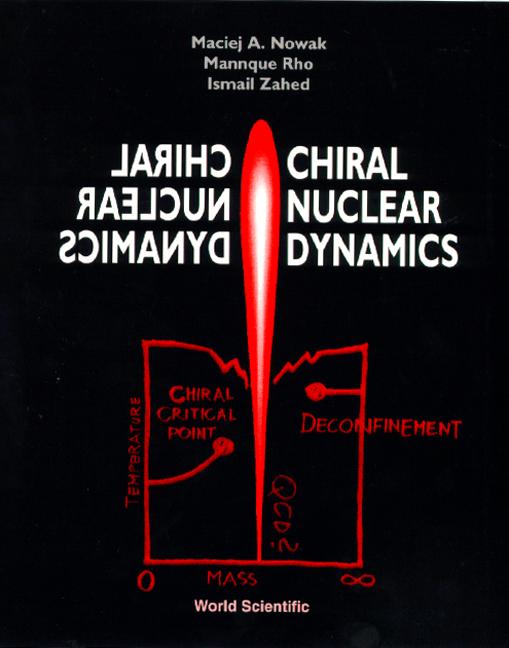
The physics of strongly interacting many-body systems known as nuclear physics is a mature discipline which has achieved a remarkably quantitative success. It has explained with an impressive accuracy the properties of nuclei from the deuteron to heavy nuclei containing several hundreds of nucleons. This is the more remarkable when one realizes that in no way did the success depend on the existence of, or knowledge derived from, the fundamental theory of strong interactions now believed to be quantum chromodynamics (QCD).This monograph is a first, albeit embryonic, attempt to explain how a nucleus can be understood without invoking the explicit degrees of freedom of quarks and gluons while still staying within the basic premise of QCD and furthermore why do quark-gluon signatures not show up prominently in nuclear processes, including those processes involving short-distance encounters within nuclei. Such an understanding is largely based on the modern concepts of broken chiral symmetry and is believed to be essential in uncovering new physics expected to figure in the hadronic environment under extreme conditions of high temperature and/or high density.
Pay easily by card, Klarna, Apple Pay or Google Pay. Not happy? You always have a 14-day money-back guarantee. Read more in our terms. If you have any questions, email us at hello@memmo.org.
Memmo makes studying easier – wherever you are in the world. We bring your course books and smart study tools together in one place: summaries, quizzes, podcasts and flashcards. Plus Ted, your study buddy who answers anything you wonder. Over 50,000 students already study here – built to help you learn faster and stress less.
You might also like
Buy the book0