
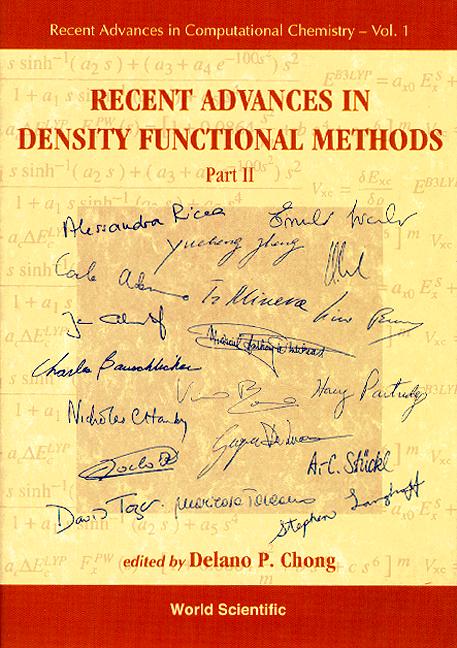
Of all the different areas in computational chemistry, density functional theory (DFT) enjoys the most rapid development. Even at the level of the local density approximation (LDA), which is computationally less demanding, DFT can usually provide better answers than Hartree-Fock formalism for large systems such as clusters and solids. For atoms and molecules, the results from DFT often rival those obtained by ab initio quantum chemistry, partly because larger basis sets can be used. Such encouraging results have in turn stimulated workers to further investigate the formal theory as well as the computational methodology of DFT.This Part II expands on the methodology and applications of DFT. Some of the chapters report on the latest developments (since the publication of Part I in 1995), while others extend the applications to wider range of molecules and their environments. Together, this and other recent review volumes on DFT show that DFT provides an efficient and accurate alternative to traditional quantum chemical methods. Such demonstration should hopefully stimulate frutiful developments in formal theory, better exchange-correlation functionals, and linear scaling methodology.
Pay easily by card, Klarna, Apple Pay or Google Pay. Not happy? You always have a 14-day money-back guarantee. Read more in our terms. If you have any questions, email us at hello@memmo.org.
Memmo makes studying easier – wherever you are in the world. We bring your course books and smart study tools together in one place: summaries, quizzes, podcasts and flashcards. Plus Ted, your study buddy who answers anything you wonder. Over 75,000 students already study here – built to help you learn faster and stress less.
You might also like
Buy the book0