
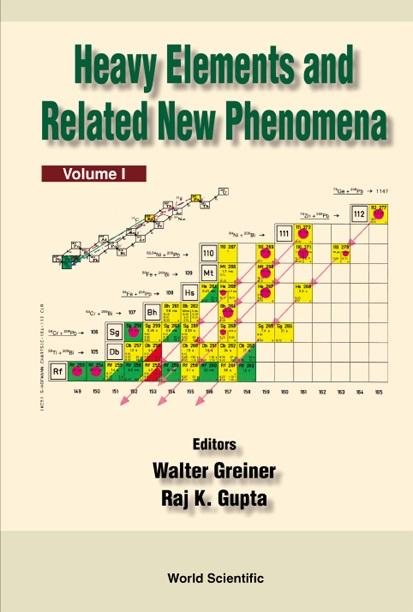
This book reviews recent developments in the field of superheavy elements and the related phenomena of fission, cluster radioactivity, and drip line physics. Both the experimental and theoretical aspects are dealt with in detail. For the production of new elements in the laboratory, the process of cold compound nucleus formation is found to be most favorable both theoretically and experimentally. However, experimentally, hot fusion of nuclei has also been used. Both the physical and chemical methods of synthesizing new elements are discussed. The theoretical approaches considered here are those of the quantum-mechanical fragmentation theory, the self-consistent Hartree-Fock theory, and the relativistic mean field theory. Fission, a process inverse to the fusion of two nuclei, is also observed to be most favourably a cold phenomenon. Other important results are bi-modal fission and high n-multiplicity fission, which leads to the hyperdeformed scission mode. Cluster radioactivity is discussed both as a heavy cluster emission process and as super-asymmetric fission. The theory as well as the present experimental status are reviewed. Physics at drip lines is interesting not only for their structural properties but also for their use in the fusion of two nuclei; both aspects are discussed.
Pay easily by card, Klarna, Apple Pay or Google Pay. Not happy? You always have a 14-day money-back guarantee. Read more in our terms. If you have any questions, email us at hello@memmo.org.
Memmo makes studying easier – wherever you are in the world. We bring your course books and smart study tools together in one place: summaries, quizzes, podcasts and flashcards. Plus Ted, your study buddy who answers anything you wonder. Over 50,000 students already study here – built to help you learn faster and stress less.
You might also like
Buy the book0