
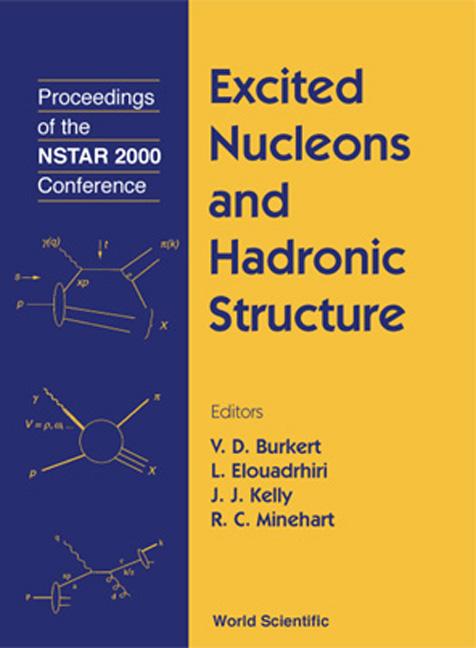
The conference NSTAR 2000 was part of a series of conferences and workshops that began in New York in 1988. Since then, the field of excited nucleons and hadron structure has developed enormously, and the scope has broadened. Most significantly, new experimental facilities have come into operation, allowing precise measurements of resonance couplings and transition form factors. The search for “missing” quark model states and gluonic excitations in complex hadronic channels is now possible.On the theory side, new and promising developments have emerged: quark models with meson degrees of freedom, hybrid baryon models, and studies of baryons in the limit of many colors. For the first time, lattice QCD has been employed to calculate masses of excited nucleons. Nucleon resonances are now recognized as providing significant contributions to the nucleon spin sum rules, as well as the Gerasimov-Drell-Hearn and Bjorken integrals, at finite momentum transfer.
Pay easily by card, Klarna, Apple Pay or Google Pay. Not happy? You always have a 14-day money-back guarantee. Read more in our terms. If you have any questions, email us at hello@memmo.org.
Memmo makes studying easier – wherever you are in the world. We bring your course books and smart study tools together in one place: summaries, quizzes, podcasts and flashcards. Plus Ted, your study buddy who answers anything you wonder. Over 50,000 students already study here – built to help you learn faster and stress less.
You might also like
Buy the book0