
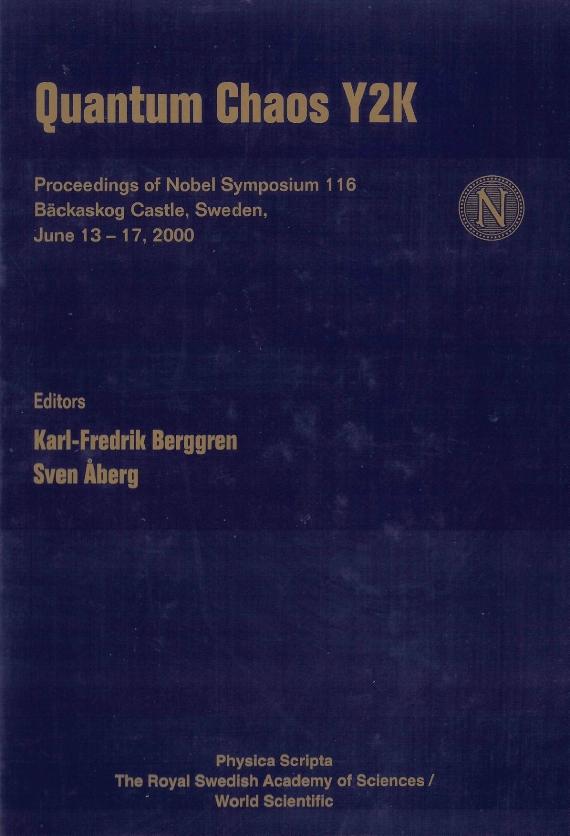
Quantum chaos is becoming a very wide field that ranges from experiments to theoretical physics and purely mathematical issues. In view of this grand span, Nobel Symposium 116 focused on experiments and theory, and attempted to encourage interplay between them. There was emphasis on the interdisciplinary character of the subject, involving a broad range of subjects in physics, including condensed matter physics, nuclear physics, atomic physics and elementary particle physics. The physics involved in quantum chaos has much in common with acoustics, microwaves, optics, etc., and therefore the symposium also covered aspects of wave chaos in this broader sense. The program was structured according to the following areas: manifestations of classical chaos in quantum systems; transport phenomena; quantal spectra in terms of periodic orbits; semiclassical and random matrix approaches; quantum chaos in interacting systems; chaos and tunneling; wave-dynamic chaos. This important book constitutes the proceedings of the symposium.
Pay easily by card, Klarna, Apple Pay or Google Pay. Not happy? You always have a 14-day money-back guarantee. Read more in our terms. If you have any questions, email us at hello@memmo.org.
Memmo makes studying easier – wherever you are in the world. We bring your course books and smart study tools together in one place: summaries, quizzes, podcasts and flashcards. Plus Ted, your study buddy who answers anything you wonder. Over 50,000 students already study here – built to help you learn faster and stress less.
You might also like
Buy the book0