
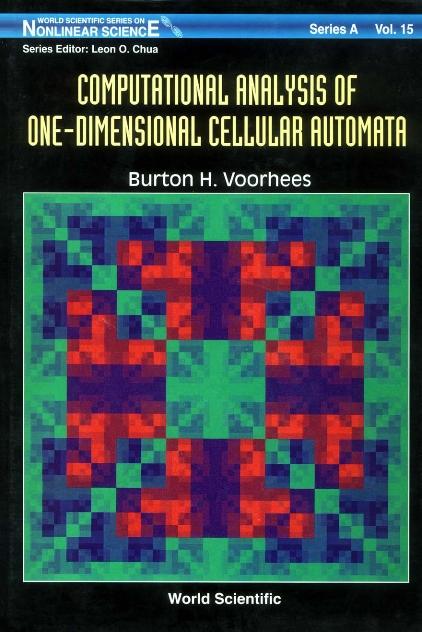
Cellular automata provide one of the most interesting avenues into the study of complex systems in general, as well as having an intrinsic interest of their own. Because of their mathematical simplicity and representational robustness they have been used to model economic, political, biological, ecological, chemical, and physical systems. Almost any system which can be treated in terms of a discrete representation space in which the dynamics is based on local interaction rules can be modelled by a cellular automata.The aim of this book is to give an introduction to the analysis of cellular automata (CA) in terms of an approach in which CA rules are viewed as elements of a nonlinear operator algebra, which can be expressed in component form much as ordinary vectors are in vector algebra. Although a variety of different topics are covered, this viewpoint provides the underlying theme. The actual mathematics used is not hard, and the material should be accessible to anyone with a junior level university background, and a certain degree of mathematical maturity.
Pay easily by card, Klarna, Apple Pay or Google Pay. Not happy? You always have a 14-day money-back guarantee. Read more in our terms. If you have any questions, email us at hello@memmo.org.
Memmo makes studying easier – wherever you are in the world. We bring your course books and smart study tools together in one place: summaries, quizzes, podcasts and flashcards. Plus Ted, your study buddy who answers anything you wonder. Over 75,000 students already study here – built to help you learn faster and stress less.
You might also like
Buy the book0