
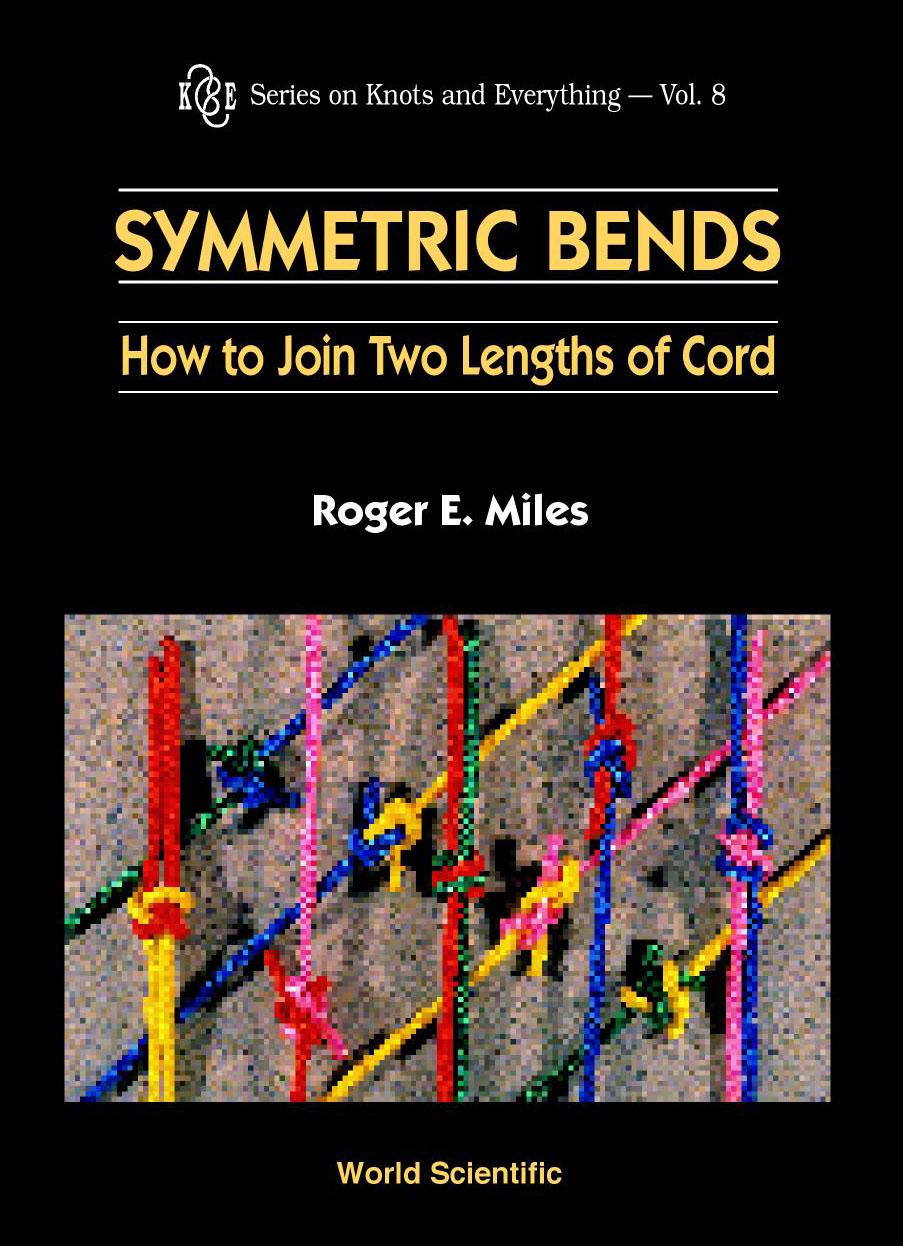
A bend is a knot securely joining together two lengths of cord (or string or rope), thereby yielding a single longer length. There are many possible different bends, and a natural question that has probably occurred to many is: “Is there a ‘best’ bend and, if so, what is it?”Most of the well-known bends happen to be symmetric — that is, the two constituent cords within the bend have the same geometric shape and size, and interrelationship with the other. Such ‘symmetric bends’ have great beauty, especially when the two cords bear different colours. Moreover, they have the practical advantage of being easier to tie (with less chance of error), and of probably being stronger, since neither end is the weaker.This book presents a mathematical theory of symmetric bends, together with a simple explanation of how such bends may be invented. Also discussed are the additionally symmetric ‘triply symmetric’ bends. Full details, including beautiful colour pictures, are given of the ‘best 60’ known symmetric bends, many of which were created by these methods of invention.This work will appeal to many — mathematicians as well as non-mathematicians interested in beautiful and useful knots.
Pay easily by card, Klarna, Apple Pay or Google Pay. Not happy? You always have a 14-day money-back guarantee. Read more in our terms. If you have any questions, email us at hello@memmo.org.
Memmo makes studying easier – wherever you are in the world. We bring your course books and smart study tools together in one place: summaries, quizzes, podcasts and flashcards. Plus Ted, your study buddy who answers anything you wonder. Over 75,000 students already study here – built to help you learn faster and stress less.
You might also like
Buy the book0