
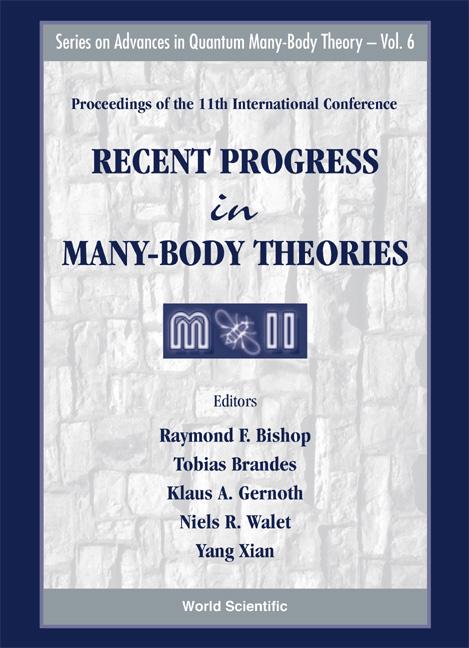
Quantum many-body theory as a discipline in its own right dates largely from the 1950's. It has developed since then to its current position as one of the cornerstones of modern theoretical physics. The field remains vibrant and active, vigorous and exciting. Its most powerful techniques are truly universal. They are constantly expanding to find new fields of application, while advances continue to be made in the more traditional areas. To commemorate the impending 80th birthdays of its two co-inventors, Firtz Coester and Hermann Kümmel, one such technique, namely the coupled cluster method, was especially highlighted at this meeting, the eleventh in the series of International Conferences on Recent Progress in Many-Body Theories. The history of the coupled cluster method as told here mirrors in many ways both the development of the entire discipline of microscopic quantum many-body theory and the history of the series of conferences. The series itself is universally recognised as being the premier series of meetings in this subject area. Its proceedings have always summarised the current state of the art through the lectures of its leading practitioners. The present volume is no exception. No serious researcher in quantum many-body theory or in any field which uses it can afford to be without this volume.
Pay easily by card, Klarna, Apple Pay or Google Pay. Not happy? You always have a 14-day money-back guarantee. Read more in our terms. If you have any questions, email us at hello@memmo.org.
Memmo makes studying easier – wherever you are in the world. We bring your course books and smart study tools together in one place: summaries, quizzes, podcasts and flashcards. Plus Ted, your study buddy who answers anything you wonder. Over 50,000 students already study here – built to help you learn faster and stress less.
You might also like
Buy the book0