
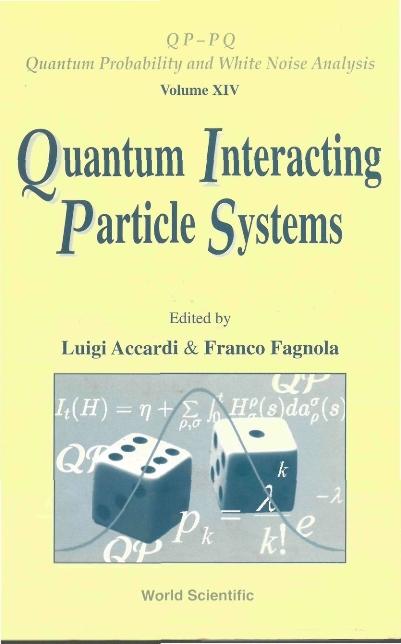
The problem of extending ideas and results on the dynamics of infinite classical lattice systems to the quantum domain naturally arises in different branches of physics (nonequilibrium statistical mechanics, quantum optics, solid state, …) and new momentum from the development of quantum computer and quantum neural networks (which are in fact interacting arrays of binary systems) has been found.The stochastic limit of quantum theory allowed to deduce, as limits of the usual Hamiltonian systems, a new class of quantum stochastic flows which, when restricted to an appropriate Abelian subalgebra, produces precisely those interacting particle systems studied in classical statistical mechanics.Moreover, in many interesting cases, the underlying classical process “drives” the quantum one, at least as far as ergodicity or convergence to equilibrium are concerned. Thus many deep results concerning classical systems can be directly applied to carry information on the corresponding quantum system. The thermodynamic limit itself is obtained thanks to a technique (the four-semigroup method, new even in the classical case) which reduces the infinitesimal structure of a stochastic flow to that of four semigroups canonically associated to it (Chap. 1).Simple and effective methods to analyze qualitatively the ergodic behavior of quantum Markov semigroups are discussed in Chap. 2.Powerful estimates used to control the infinite volume limit, ergodic behavior and the spectral gap (Gaussian, exponential and hypercontractive bounds, classical and quantum logarithmic Sobolev inequalities, …) are discussed in Chap. 3.
Pay easily by card, Klarna, Apple Pay or Google Pay. Not happy? You always have a 14-day money-back guarantee. Read more in our terms. If you have any questions, email us at hello@memmo.org.
Memmo makes studying easier – wherever you are in the world. We bring your course books and smart study tools together in one place: summaries, quizzes, podcasts and flashcards. Plus Ted, your study buddy who answers anything you wonder. Over 50,000 students already study here – built to help you learn faster and stress less.
You might also like
Buy the book0