
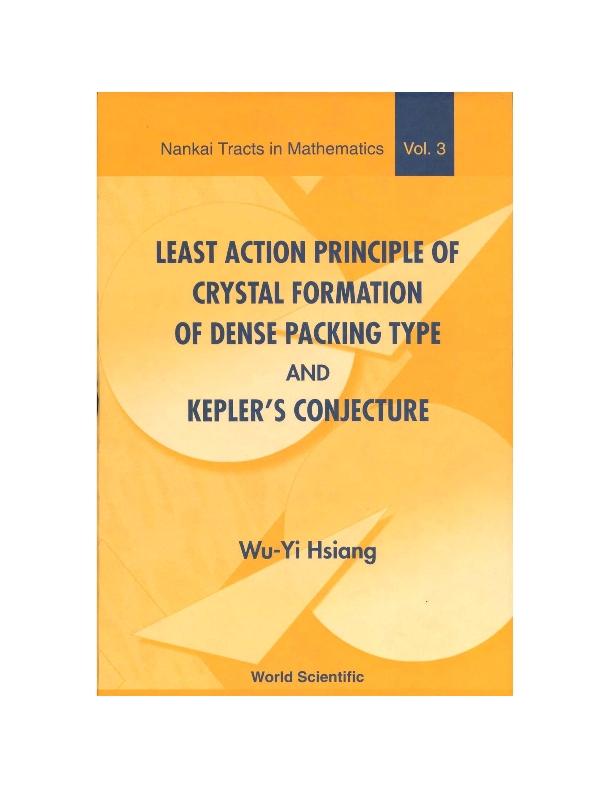
The dense packing of microscopic spheres (i.e. atoms) is the basic geometric arrangement in crystals of mono-atomic elements with weak covalent bonds, which achieves the optimal “known density” of B/√18. In 1611, Johannes Kepler had already “conjectured” that B/√18 should be the optimal “density” of sphere packings. Thus, the central problems in the study of sphere packings are the proof of Kepler's conjecture that B/√18 is the optimal density, and the establishing of the least action principle that the hexagonal dense packings in crystals are the geometric consequence of optimization of density. This important book provides a self-contained proof of both, using vector algebra and spherical geometry as the main techniques and in the tradition of classical geometry.
Pay easily by card, Klarna, Apple Pay or Google Pay. Not happy? You always have a 14-day money-back guarantee. Read more in our terms. If you have any questions, email us at hello@memmo.org.
Memmo makes studying easier – wherever you are in the world. We bring your course books and smart study tools together in one place: summaries, quizzes, podcasts and flashcards. Plus Ted, your study buddy who answers anything you wonder. Over 75,000 students already study here – built to help you learn faster and stress less.
You might also like
Buy the book0