
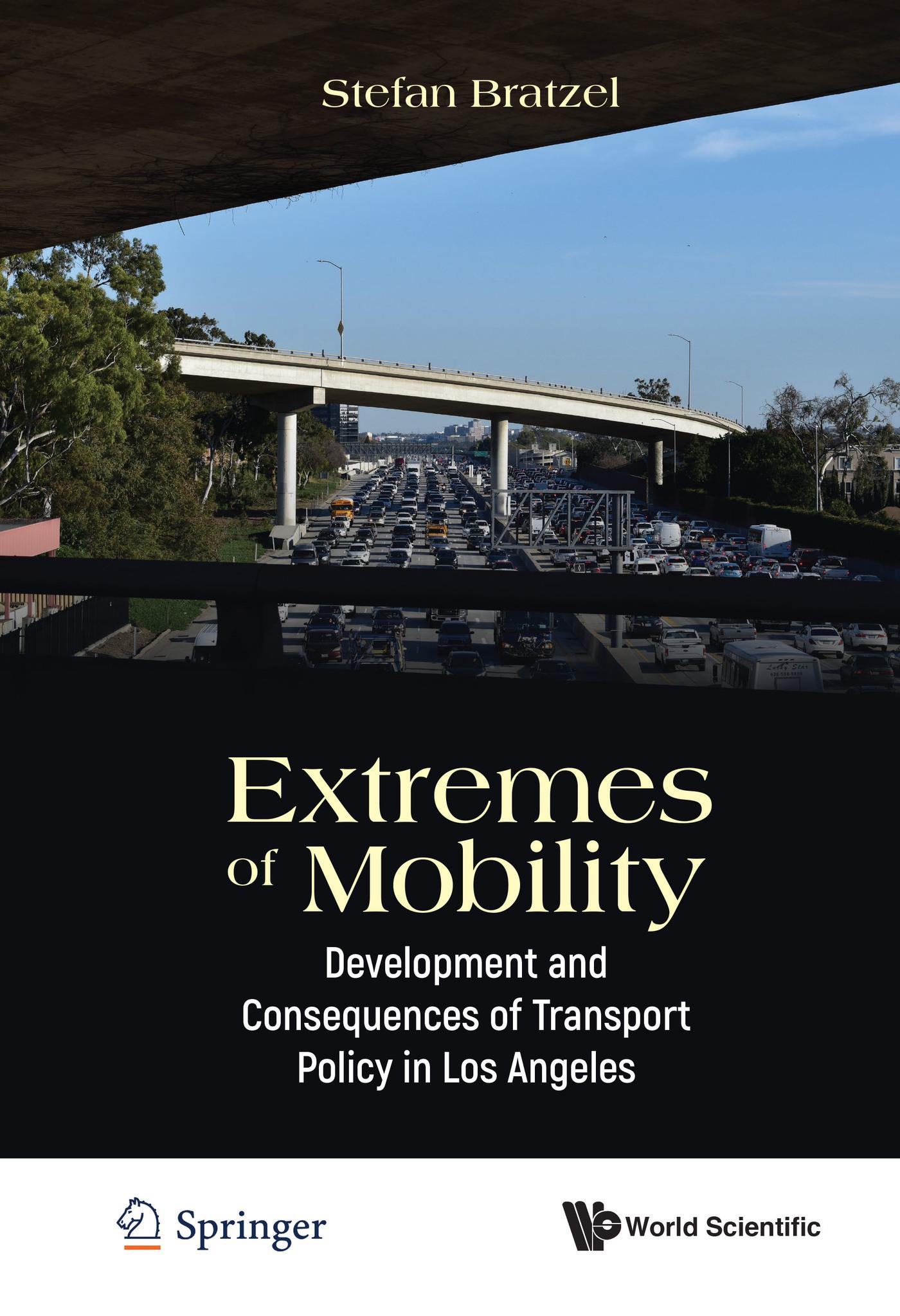
The development of transportation policy in Los Angeles is a history of extremes: in the 1920s, the city had the largest regional rail network in the world, which was completely abolished 40 years later. In its place, a vast network of freeways was built in the metropolis with a car-focused mobility pattern. Los Angeles became a symbol of car-oriented mobility with all the negative ecological and social side effects. Since the 1990s, Los Angeles has been rebuilding its public rail transport — with little success so far.
This book examines the history of Los Angeles' development and identifies the key drivers that have shaped the metropolis' extreme transport policies. With other cities facing similar — albeit less extreme — transportation issues, they can learn from how Los Angeles had responded and continues to adapt to its considerable transport policy problems, especially in order to avoid the mobility experiences faced by the American city.
But, to do so, it is necessary to abandon the prevailing perspective, which is largely limited to evaluating transport modes ('road versus rail'). A sustainable solution to the problems of metropolitan areas will only be possible if the origins of transport with their spatial, social and economic interdependencies are understood and integrated into transport policy action.
Contents:
- Introduction
- Road and Regional Railways as Dominant Modes of Transport
- Los Angeles as an Extreme Form of an Automotive Conurbation
- The Return of Rail Transport to the Metropolis
- Mobility Patterns and Public Policy in Comparison
- Explaining the Development of the Transport Policy in Los Angeles
- Back to the Future: L.A. Revisited 1990–2022
- Results and Outlook
Readership: Advanced undergraduate and graduate students, researchers and practitioners in the fields of mobility, transport policy, city planning, and urban mobility.
Key Features:
- Derives lessons and best practices on transport policy and regional planning/development from the Los Angeles case that can be adopted for other cities
- Offers fresh perspectives on transport policy, urban planning, the politics of mobility, and the development conditions of traffic with economic, ecological, and socio-cultural implications
Pay easily by card, Klarna, Apple Pay or Google Pay. Not happy? You always have a 14-day money-back guarantee. Read more in our terms. If you have any questions, email us at hello@memmo.org.
Memmo makes studying easier – wherever you are in the world. We bring your course books and smart study tools together in one place: summaries, quizzes, podcasts and flashcards. Plus Ted, your study buddy who answers anything you wonder. Over 75,000 students already study here – built to help you learn faster and stress less.