
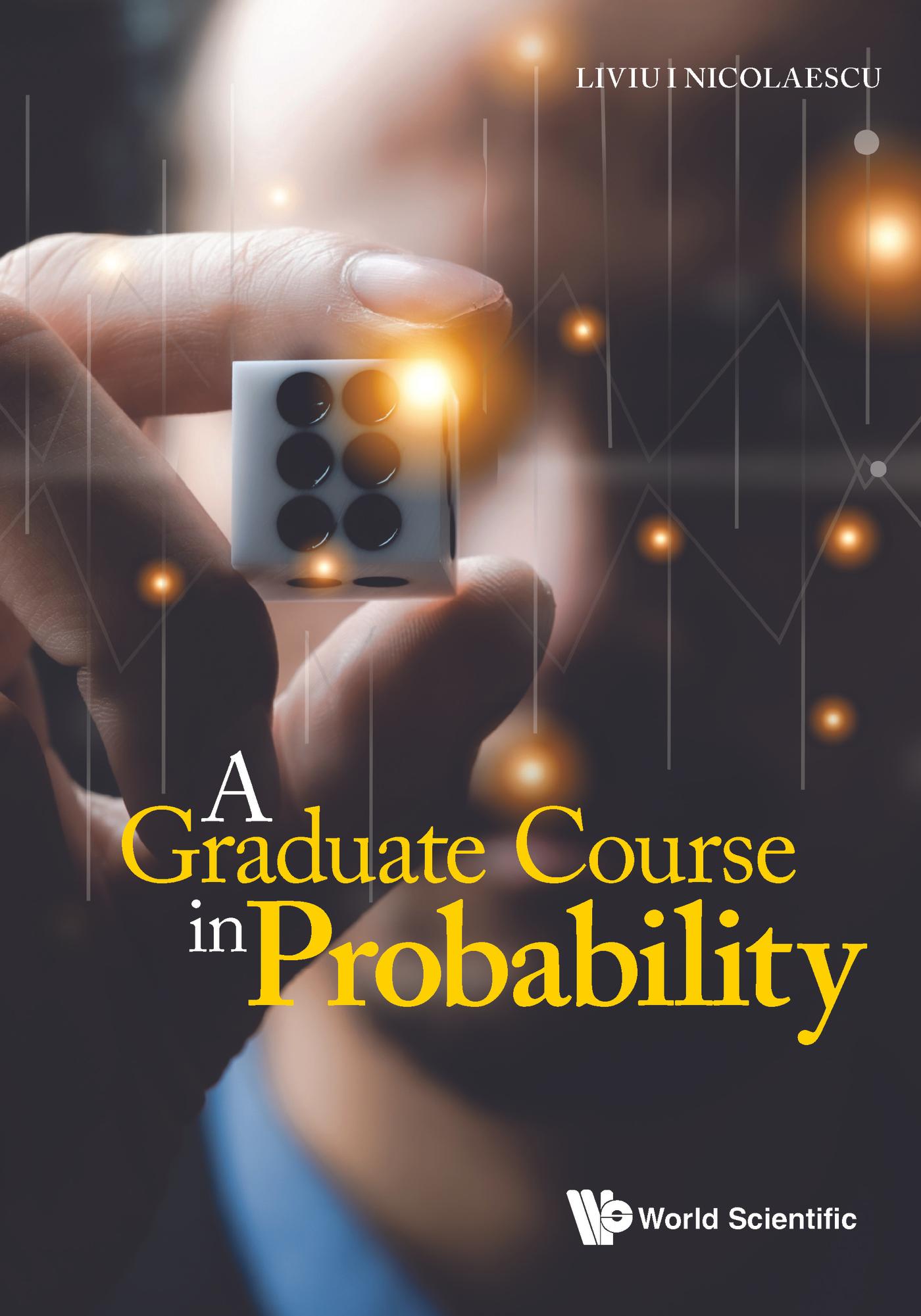
This book grew out of the notes for a one-semester basic graduate course in probability. As the title suggests, it is meant to be an introduction to probability and could serve as textbook for a year long text for a basic graduate course. It assumes some familiarity with measure theory and integration so in this book we emphasize only those aspects of measure theory that have special probabilistic uses.
The book covers the topics that are part of the culture of an aspiring probabilist and it is guided by the author's personal belief that probability was and is a theory driven by examples. The examples form the main attraction of this subject. For this reason, a large book is devoted to an eclectic collection of examples, from classical to modern, from mainstream to 'exotic'. The text is complemented by nearly 200 exercises, quite a few nontrivial, but all meant to enhance comprehension and enlarge the reader's horizons.
While teaching probability both at undergraduate and graduate level the author discovered the revealing power of simulations. For this reason, the book contains a veiled invitation to the reader to familiarize with the programing language R. In the appendix, there are a few of the most frequently used operations and the text is sprinkled with (less than optimal) R codes. Nowadays one can do on a laptop simulations and computations we could only dream as an undergraduate in the past. This is a book written by a probability outsider. That brings along a bit of freshness together with certain 'naiveties'.
Contents:
- Foundations:
- Measurable Spaces
- Measures and Integration
- Invariants of Random Variables
- Conditional Expectation
- What are Stochastic Processes?
- Exercises
- Limit Theorems
- The Law of Large Numbers
- The Central Limit Theorem
- Concentration Inequalities
- Uniform Laws of Large Numbers
- The Brownian motion
- Exercises
- Martingales
- Basic Facts about Martingales
- Limit Theorems: Discrete Time
- Continuous Time Martingales
- Exercises
- Markov Chains
- Markov Chains
- The dynamics of homogeneous Markov chains
- Asymptotic behavior
- Electric networks
- Finite Markov chains
- Exercises
- Elements of Ergodic Theory
- The Ergodic Theorem
- Applications
- Exercises
- Appendix A: A Few Useful facts
- The Gamma function
- Basic Invariants of Frequently Used Probability Distributions
- A Glimpse at R
Readership: Graduate students, advanced undergraduates, mathematicians. Suitable for a first year graduate course in probability.
Pay easily by card, Klarna, Apple Pay or Google Pay. Not happy? You always have a 14-day money-back guarantee. Read more in our terms. If you have any questions, email us at hello@memmo.org.
Memmo makes studying easier – wherever you are in the world. We bring your course books and smart study tools together in one place: summaries, quizzes, podcasts and flashcards. Plus Ted, your study buddy who answers anything you wonder. Over 75,000 students already study here – built to help you learn faster and stress less.