
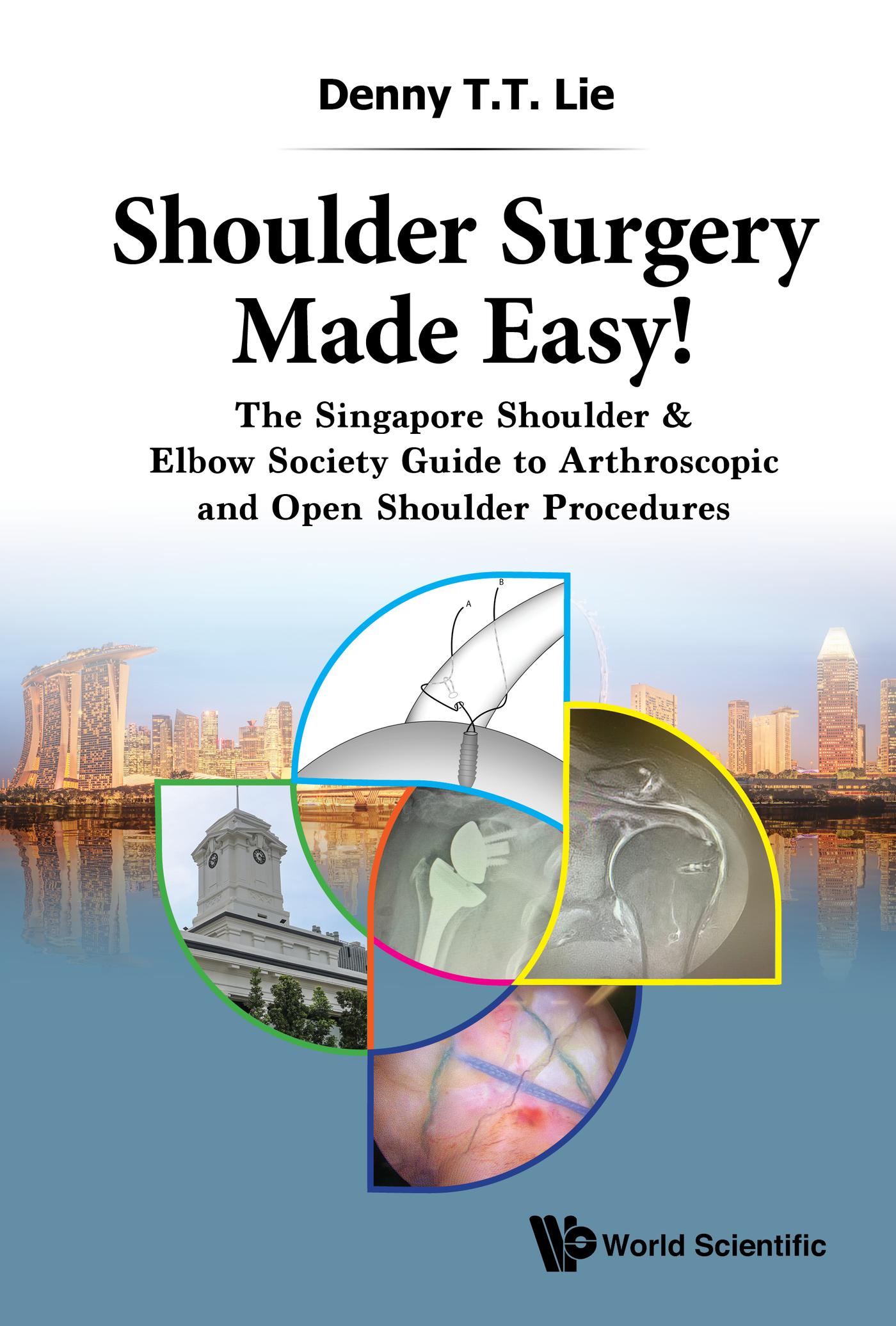
What is causing the shoulder pain? How does one prepare for arthroscopic shoulder surgery? What is adequate subacromial decompression? How does one stabilize the lax capsule in the Asian shoulder? Which of the many suture configurations should one use for the many tear morphologies?
Shoulder surgery, especially arthroscopic procedures, have seen a dramatic increase in the past 10 years. With improved diagnostic modalities, increased awareness and rapid advances in implant technologies, the minimally invasive surgical option has been more appealing to patients.
This shoulder arthroscopic surgery guide attempts to answer the questions above, and was written as a quick reference and guide for Orthopaedic residents and practicing surgeons, with proven techniques developed by the author and contributors over the past 15 years. Each surgical technique has proven published results and thus provides an assurance to the readers that these techniques are reproducible.
The book starts with a chapter dedicated to a diagnostic approach to shoulder problems, often a confusing symptom that is not well studied. More than 22 surgical techniques are described in detail, in succinct and simple point-forms, each chapter beginning with an introduction to the problem, the surgical technique which the author(s) found useful, post-op care and ending off with the clinical results of this technique.
Contents:
- History-Taking and Physical Examination of the Shoulder (Denny T T Lie)
- Imaging of the Shoulder (Lim Chee Yeong)
- Patient Positioning, Anaesthesia and OT Preparations (Denny T T Lie, Geoffrey Liew and Dennis Ng)
- The Normal Shoulder — The Arthroscopic Routine in the Gleno-humeral Joint and the Subacromial Space (Denny T T Lie and Bryan Wang)
- Arthroscopic Capsular Release for Adhesive Capsulitis (Denny T T Lie and Mak Wai Keong)
- Arthroscopic Labral Repair and Capsular Shift — The Hybrid Technique Using Modified Mason-Allen Suture Configuration (Denny T T Lie and Lai Mun Chun)
- Approach to Glenoid Bone Loss Arthroscopic Remplissage Procedure Using TransTend Anchor System (Andrew Chou and Denny T T Lie)
- Approach to Major Bone Loss of the Glenoid: Arthroscopic Repair of the Bony Bankart Arthroscopic Glenoid Reconstruction Using Iliac Crest Bone Graft — Eden-Hybinette Procedure (Denny T T Lie and Abby Choke)
- Arthroscopic Repair of Posterior Labral Tears (Denny T T Lie, Bryan Loh and Lim Mui Hong)
- Arthroscopic Repair of Superior Labral (SLAP) Tears (Denny T T Lie, Thomas Kuo and Zhu Meng)
- Arthroscopic Biceps Tenotomy and Tenodesis (Denny T T Lie and Don Koh)
- Arthroscopic Repair of Subscapularis Tears (Denny T T Lie and Jeremy K M Goh)
- Arthroscopic Subacromial Decompression and Acromioplasty Arthroscopic Mumford's Procedure (Denny T T Lie and Punn Kuhataparuks)
- Arthroscopic Repair of Partial Tears (Denny T T Lie and Cheow Xunqi)
- Arthroscopic Dual-Row Cuff Repairs for Small to Mid-sized Full Thickness Tears (Denny T T Lie, Merrill Lee and Eileen Tay)
- Large Rotator Cuff Tears: Classification and Approach Arthroscopic Margin Convergence (the Boot-Lace Technique) and Cuff Repair (Denny T T Lie and Gerald Zeng)
- Massive Cuff Tears — Options and Approach Arthroscopic Partial Repair with Superior Capsular Reconstruction Arthroscopic-Assisted Latissimus Dorsi Transfer (Denny T T Lie, Desmond Ong and Gerald Zeng)
- Arthroscopic Reconstruction of the Acromio-Clavicular Joint (Denny T T Lie and Hamid Rahmatullah Bin Abd Razak)
- Arthroscopic Bursoscopy and Debridement of the Scapula (Denny T T Lie and Gerald Zeng)
- Proximal Humeral Head Fracture Fixation — The Fibula Graft Strut Technique (Denny T T Lie, Wong Merng Koon and Edwin Tan)
- Humeral Hemiarthroplasty for Humeral Head Fractures (Denny T T Lie and Puah Ken Lee)
- Reverse Shoulder Arthroplasty — Tips and Pearls (Denny T T Lie, Mak Wai Keong and Ruben Manohara)
Readership: Primary market: Orthopaedic residents and practicing Orthopaedic surgeons in Singapore and regional countries in Asia especially India and China. Useful for higher post-grad Orthopaedic exams, and could serve as text guides in shoulder arthroscopy courses. Secondary markets: Advanced medical undergraduate, post-graduate allied healthcare staff, and researchers interested in shoulder surgery. This book would also be of interest to implant industry managers in their educational and marketing efforts.
Key Features:
- Well-proven surgical techniques developed over 15 years in one of Asia's busiest hospitalsAll techniques are substantiated by published clinical results
- Key facts are summarized, techniques written in succinct and simple language, presented in point-form for easy reading
- Richly illustrated with more than 280 surgical pictures, diagrams and flow-charts
- Comprehensive approach to common shoulder problems, beginning with a diagnostic approach and physical examination in chapter 1, followed by imaging of the shoulder (chapter 2) and then pre-surgical preparations in chapter 3
- 19 chapters are dedicated to describing more than 22 surgical procedures; each chapter beginning with surgical indications, techniques, post-op care and outcomes
- A first for Singapore medicine; first shoulder surgical textbook by members of the Singapore Shoulder & Elbow Society
- A wide potential market in neighbouring countries where Singapore surgeons and members of SSES often teach
Pay easily by card, Klarna, Apple Pay or Google Pay. Not happy? You always have a 14-day money-back guarantee. Read more in our terms. If you have any questions, email us at hello@memmo.org.
Memmo makes studying easier – wherever you are in the world. We bring your course books and smart study tools together in one place: summaries, quizzes, podcasts and flashcards. Plus Ted, your study buddy who answers anything you wonder. Over 75,000 students already study here – built to help you learn faster and stress less.