
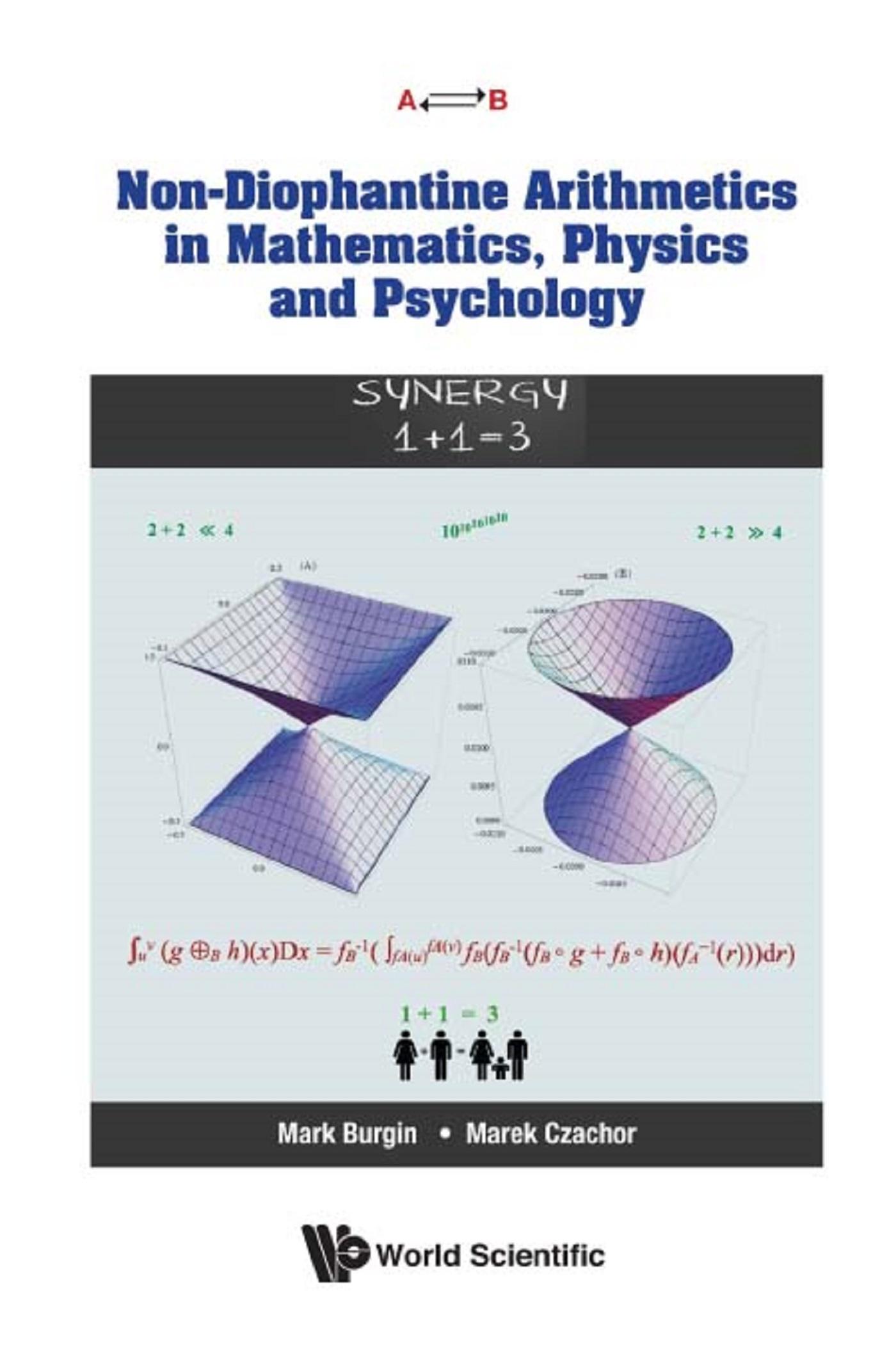
For a long time, all thought there was only one geometry — Euclidean geometry. Nevertheless, in the 19th century, many non-Euclidean geometries were discovered. It took almost two millennia to do this. This was the major mathematical discovery and advancement of the 19th century, which changed understanding of mathematics and the work of mathematicians providing innovative insights and tools for mathematical research and applications of mathematics.A similar event happened in arithmetic in the 20th century. Even longer than with geometry, all thought there was only one conventional arithmetic of natural numbers — the Diophantine arithmetic, in which 2+2=4 and 1+1=2. It is natural to call the conventional arithmetic by the name Diophantine arithmetic due to the important contributions to arithmetic by Diophantus. Nevertheless, in the 20th century, many non-Diophantine arithmetics were discovered, in some of which 2+2=5 or 1+1=3. It took more than two millennia to do this. This discovery has even more implications than the discovery of new geometries because all people use arithmetic.This book provides a detailed exposition of the theory of non-Diophantine arithmetics and its various applications. Reading this book, the reader will see that on the one hand, non-Diophantine arithmetics continue the ancient tradition of operating with numbers while on the other hand, they introduce extremely original and innovative ideas.
Pay easily by card, Klarna, Apple Pay or Google Pay. Not happy? You always have a 14-day money-back guarantee. Read more in our terms. If you have any questions, email us at hello@memmo.org.
Memmo makes studying easier – wherever you are in the world. We bring your course books and smart study tools together in one place: summaries, quizzes, podcasts and flashcards. Plus Ted, your study buddy who answers anything you wonder. Over 75,000 students already study here – built to help you learn faster and stress less.
You might also like
Buy the book0