
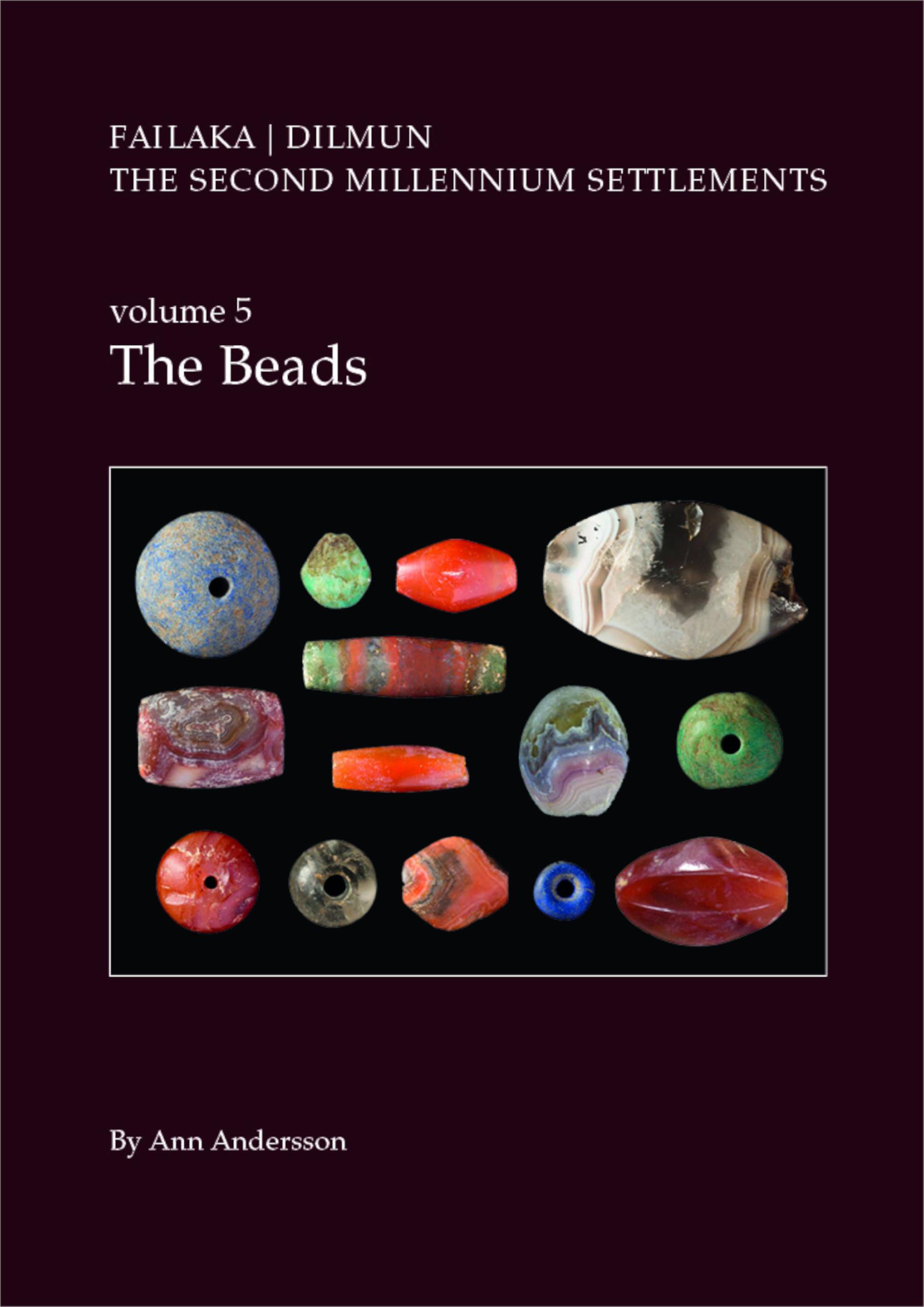
Excavations in 1958-1963 on the island of Failaka in Kuwait uncovered a small community of Dilmun traders from the second millennium BC. Prominent among the finds were 629 beads, most of them made of semi-precious stone, such as different varieties of chalcedony (agate, carnelian, jasper, and moss agate) and quartz (rock crystal, milky quartz, and smoky quartz), and a range of other stone types, such as calcite, chlorite, lapis lazuli, turquoise and porphyry. Additionally, part of the beads was made of glass: a new prestige material of the second millennium.
The study consists of a typology, a classification of materials and an analysis of the dating and distribution of the beads. Manufacturing techniques, including perforation and use-wear, are also considered. In a final discussion, the bead corpus from Failaka is compared with similar material from contemporary sites on Failaka and in Bahrain, along with some thoughts on connections and trade relations, which may be inferred from the materials and forms in the bead assemblage. The study proposes far-reaching connections with the Indus in the east and the Aegean in the west.
Pay easily by card, Klarna, Apple Pay or Google Pay. Not happy? You always have a 14-day money-back guarantee. Read more in our terms. If you have any questions, email us at hello@memmo.org.
Memmo makes studying easier – wherever you are in the world. We bring your course books and smart study tools together in one place: summaries, quizzes, podcasts and flashcards. Plus Ted, your study buddy who answers anything you wonder. Over 75,000 students already study here – built to help you learn faster and stress less.
You might also like
Buy the book0