
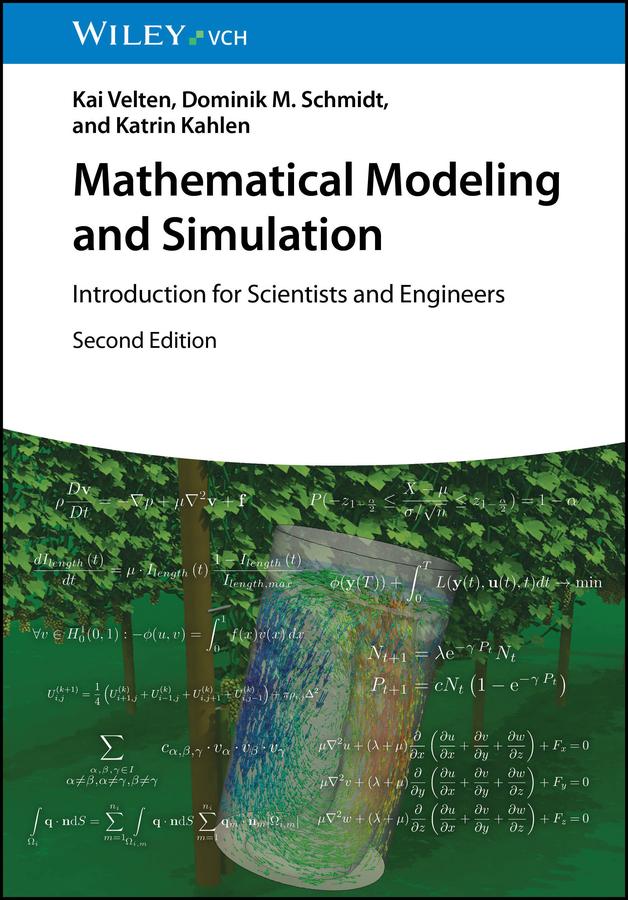
Learn to use modeling and simulation methods to attack real-world problems, from physics to engineering, from life sciences to process engineering
Reviews of the first edition (2009):
"Perfectly fits introductory modeling courses [...] and is an enjoyable reading in the first place. Highly recommended [...]"
Zentralblatt MATH, European Mathematical Society, 2009
"This book differs from almost all other available modeling books in that [the authors address] both mechanistic and statistical models as well as 'hybrid' models. [...] The modeling range is enormous."
SIAM Society of Industrial and Applied Mathematics, USA, 2011
This completely revised and substantially extended second edition answers the most important questions in the field of modeling: What is a mathematical model? What types of models do exist? Which model is appropriate for a particular problem? What are simulation, parameter estimation, and validation? What kind of mathematical problems appear and how can these be efficiently solved using professional free of charge open source software?
The book addresses undergraduates and practitioners alike. Although only basic knowledge of calculus and linear algebra is required, the most important mathematical structures are discussed in sufficient detail, ranging from statistical models to partial differential equations and accompanied by examples from biology, ecology, economics, medicine, agricultural, chemical, electrical, mechanical, and process engineering.
About 200 pages of additional material include a unique chapter on virtualization, Crash Courses on the data analysis and programming languages R and Python and on the computer algebra language Maxima, many new methods and examples scattered throughout the book, an update of all software-related procedures, and a comprehensive book software providing templates for typical modeling tasks in thousands of code lines. The book software includes GmLinux, an operating system specifically designed for this book providing preconfigured and ready-to-use installations of OpenFOAM, Salome, FreeCAD/CfdOF workbench, ParaView, R, Maxima/wxMaxima, Python, Rstudio, Quarto/Markdown and other free of charge open source software used in the book.
Pay easily by card, Klarna, Apple Pay or Google Pay. Not happy? You always have a 14-day money-back guarantee. Read more in our terms. If you have any questions, email us at hello@memmo.org.
Memmo makes studying easier – wherever you are in the world. We bring your course books and smart study tools together in one place: summaries, quizzes, podcasts and flashcards. Plus Ted, your study buddy who answers anything you wonder. Over 75,000 students already study here – built to help you learn faster and stress less.