
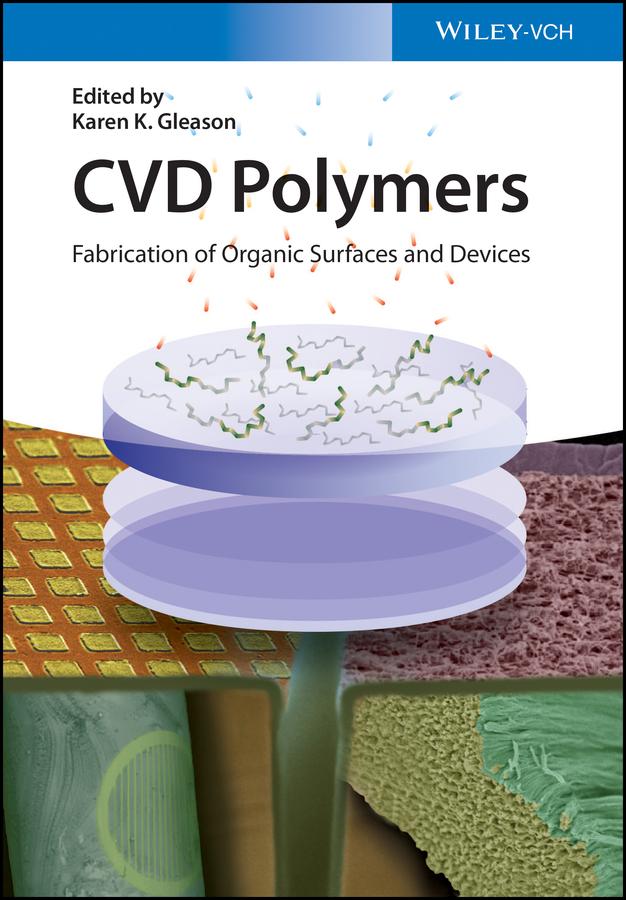
The method of CVD (chemical vapor deposition) is a versatile technique to fabricate high-quality thin films and structured surfaces in the nanometer regime from the vapor phase. Already widely used for the deposition of inorganic materials in the semiconductor industry, CVD has become the method of choice in many applications to process polymers as well. This highly scalable technique allows for synthesizing high-purity, defect-free films and for systematically tuning their chemical, mechanical and physical properties. In addition, vapor phase processing is critical for the deposition of insoluble materials including fluoropolymers, electrically conductive polymers, and highly crosslinked organic networks. Furthermore, CVD enables the coating of substrates which would otherwise dissolve or swell upon exposure to solvents.
The scope of the book encompasses CVD polymerization processes which directly translate the chemical mechanisms of traditional polymer synthesis and organic synthesis in homogeneous liquids into heterogeneous processes for the modification of solid surfaces. The book is structured into four parts, complemented by an introductory overview of the diverse process strategies for CVD of polymeric materials. The first part on the fundamentals of CVD polymers is followed by a detailed coverage of the materials chemistry of CVD polymers, including the main synthesis mechanisms and the resultant classes of materials. The third part focuses on the applications of these materials such as membrane modification and device fabrication. The final part discusses the potential for scale-up and commercialization of CVD polymers.
The scope of the book encompasses CVD polymerization processes which directly translate the chemical mechanisms of traditional polymer synthesis and organic synthesis in homogeneous liquids into heterogeneous processes for the modification of solid surfaces. The book is structured into four parts, complemented by an introductory overview of the diverse process strategies for CVD of polymeric materials. The first part on the fundamentals of CVD polymers is followed by a detailed coverage of the materials chemistry of CVD polymers, including the main synthesis mechanisms and the resultant classes of materials. The third part focuses on the applications of these materials such as membrane modification and device fabrication. The final part discusses the potential for scale-up and commercialization of CVD polymers.
Pay easily by card, Klarna, Apple Pay or Google Pay. Not happy? You always have a 14-day money-back guarantee. Read more in our terms. If you have any questions, email us at hello@memmo.org.
Memmo makes studying easier – wherever you are in the world. We bring your course books and smart study tools together in one place: summaries, quizzes, podcasts and flashcards. Plus Ted, your study buddy who answers anything you wonder. Over 75,000 students already study here – built to help you learn faster and stress less.