
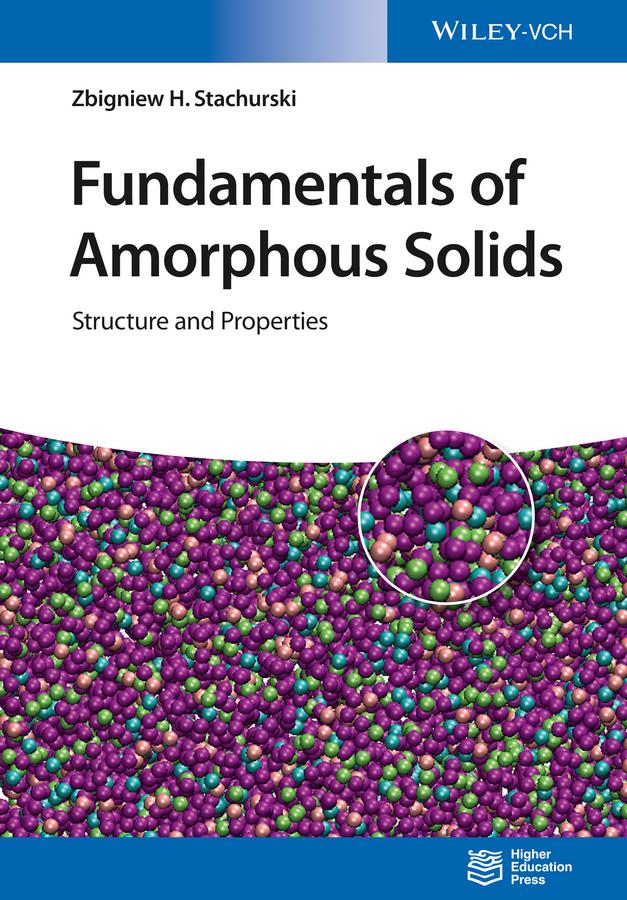
Long awaited, this textbook fills the gap for convincing concepts to describe amorphous solids.
Adopting a unique approach, the author develops a framework that lays the foundations for a theory of amorphousness. He unravels the scientific mysteries surrounding the topic, replacing rather vague notions of amorphous materials as disordered crystalline solids with the well-founded concept of ideal amorphous solids. A classification of amorphous materials into inorganic glasses, organic glasses, glassy metallic alloys, and thin films sets the scene for the development of the model of ideal amorphous solids, based on topology- and statistics-governed rules of three-dimensional sphere packing, which leads to structures with no short, mid or long-range order. This general model is then concretized to the description of specific compounds in the four fundamental classes of amorphous solids, as well as amorphous polyethylene and poly(methyl)methacrylate, emphasizing its versatility and descriptive power. Finally, he includes example applications to indicate the abundance of amorphous materials in modern-day technology, thus illustrating the importance of a better understanding of their structure and properties.
Equally ideal as supplementary reading in courses on crystallography, mineralogy, solid state physics, and materials science where amorphous materials have played only a minor role until now.
Adopting a unique approach, the author develops a framework that lays the foundations for a theory of amorphousness. He unravels the scientific mysteries surrounding the topic, replacing rather vague notions of amorphous materials as disordered crystalline solids with the well-founded concept of ideal amorphous solids. A classification of amorphous materials into inorganic glasses, organic glasses, glassy metallic alloys, and thin films sets the scene for the development of the model of ideal amorphous solids, based on topology- and statistics-governed rules of three-dimensional sphere packing, which leads to structures with no short, mid or long-range order. This general model is then concretized to the description of specific compounds in the four fundamental classes of amorphous solids, as well as amorphous polyethylene and poly(methyl)methacrylate, emphasizing its versatility and descriptive power. Finally, he includes example applications to indicate the abundance of amorphous materials in modern-day technology, thus illustrating the importance of a better understanding of their structure and properties.
Equally ideal as supplementary reading in courses on crystallography, mineralogy, solid state physics, and materials science where amorphous materials have played only a minor role until now.
Pay easily by card, Klarna, Apple Pay or Google Pay. Not happy? You always have a 14-day money-back guarantee. Read more in our terms. If you have any questions, email us at hello@memmo.org.
Memmo makes studying easier – wherever you are in the world. We bring your course books and smart study tools together in one place: summaries, quizzes, podcasts and flashcards. Plus Ted, your study buddy who answers anything you wonder. Over 50,000 students already study here – built to help you learn faster and stress less.