
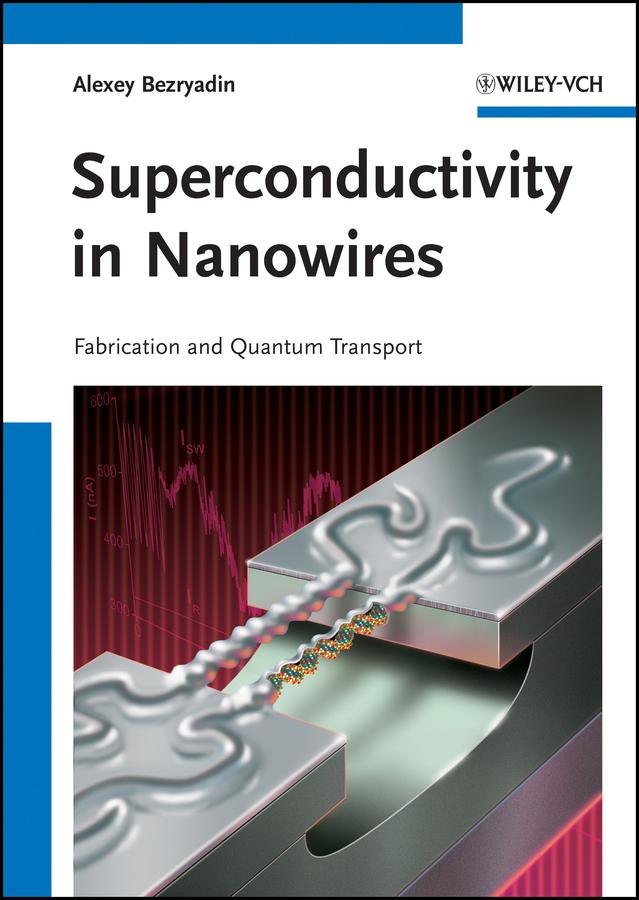
The importance and actuality of nanotechnology is unabated and will be for years to come. A main challenge is to understand the various properties of certain nanostructures, and how to generate structures with specific properties for use in actual applications in Electrical Engineering and Medicine.
One of the most important structures are nanowires, in particular superconducting ones. They are highly promising for future electronics, transporting current without resistance and at scales of a few nanometers. To fabricate wires to certain defined standards however, is a major challenge, and so is the investigation and understanding of these properties in the first place. A promising approach is to use carbon nanotubes as well as DNA structures as templates.
Many fundamental theoretical questions are still unanswered, e.g. related to the role of quantum fluctuations. This work is tackling them and provides a detailed analysis of the transport properties of such ultrathin wires. It presents an account of theoretical models, charge transport experiments, and also conveys the latest experimental findings regarding fabrication, measurements, and theoretical analysis. In particular, it is the only available resource for the approach of using DNA and carbon nanotubes for nanowire fabrication.
It is intended for graduate students and young researchers interested in nanoscale superconductivity. The readers are assumed to have knowledge of the basics of quantum mechanics and superconductivity.
One of the most important structures are nanowires, in particular superconducting ones. They are highly promising for future electronics, transporting current without resistance and at scales of a few nanometers. To fabricate wires to certain defined standards however, is a major challenge, and so is the investigation and understanding of these properties in the first place. A promising approach is to use carbon nanotubes as well as DNA structures as templates.
Many fundamental theoretical questions are still unanswered, e.g. related to the role of quantum fluctuations. This work is tackling them and provides a detailed analysis of the transport properties of such ultrathin wires. It presents an account of theoretical models, charge transport experiments, and also conveys the latest experimental findings regarding fabrication, measurements, and theoretical analysis. In particular, it is the only available resource for the approach of using DNA and carbon nanotubes for nanowire fabrication.
It is intended for graduate students and young researchers interested in nanoscale superconductivity. The readers are assumed to have knowledge of the basics of quantum mechanics and superconductivity.
Pay easily by card, Klarna, Apple Pay or Google Pay. Not happy? You always have a 14-day money-back guarantee. Read more in our terms. If you have any questions, email us at hello@memmo.org.
Memmo makes studying easier – wherever you are in the world. We bring your course books and smart study tools together in one place: summaries, quizzes, podcasts and flashcards. Plus Ted, your study buddy who answers anything you wonder. Over 50,000 students already study here – built to help you learn faster and stress less.