
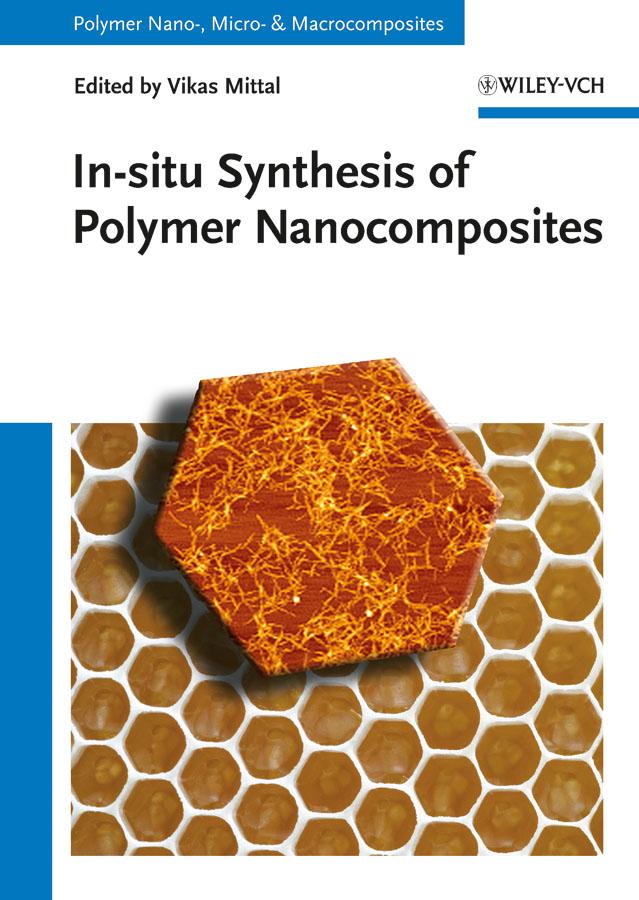
The book series "Polymer Nano-, Micro- and Macrocomposites" provides complete and comprehensive information on all important
aspects of polymer composite research and development, including, but not limited to synthesis, filler modification, modeling, characterization as well as application and commercialization issues. Each book focuses on a particular topic and gives a balanced in-depth overview of the respective subfi eld of polymer composite science and its relation to industrial applications. With the books the readers obtain dedicated resources with information relevant to their research, thereby helping to save time and money.
In-situ intercalative polymerization in the presence of filler provides distinct advantages when compared to other nanocomposite synthesis
techniques including the possibility to polymerize a large range of thermoplastic and thermosetting polymers, improved handling of gaseous
or liquid monomers or high pressure polymerization and improved control of heat of polymerization. This volume aims to highlight these
advantages of the generation of polymer nanocomposites with a large spectrum of polymer matrices. Following an overview of the synthesis
methodologies, the text goes on to discuss the most relevant polymer materials, including polyamides, polyolefi nes, polyacrylates, polyethylenes, polyurethanes, polyesters and polyepoxides.
aspects of polymer composite research and development, including, but not limited to synthesis, filler modification, modeling, characterization as well as application and commercialization issues. Each book focuses on a particular topic and gives a balanced in-depth overview of the respective subfi eld of polymer composite science and its relation to industrial applications. With the books the readers obtain dedicated resources with information relevant to their research, thereby helping to save time and money.
In-situ intercalative polymerization in the presence of filler provides distinct advantages when compared to other nanocomposite synthesis
techniques including the possibility to polymerize a large range of thermoplastic and thermosetting polymers, improved handling of gaseous
or liquid monomers or high pressure polymerization and improved control of heat of polymerization. This volume aims to highlight these
advantages of the generation of polymer nanocomposites with a large spectrum of polymer matrices. Following an overview of the synthesis
methodologies, the text goes on to discuss the most relevant polymer materials, including polyamides, polyolefi nes, polyacrylates, polyethylenes, polyurethanes, polyesters and polyepoxides.
Pay easily by card, Klarna, Apple Pay or Google Pay. Not happy? You always have a 14-day money-back guarantee. Read more in our terms. If you have any questions, email us at hello@memmo.org.
Memmo makes studying easier – wherever you are in the world. We bring your course books and smart study tools together in one place: summaries, quizzes, podcasts and flashcards. Plus Ted, your study buddy who answers anything you wonder. Over 75,000 students already study here – built to help you learn faster and stress less.