
Worldwide, the use of natural gas as a primary energy source will remain vital for decades to come. This applies to industrialized, emerging countries and developing countries. Owing to the low level of impurities, natural gas is considered to be a climate-friendly fossil fuel because of the low CO2 emissions, but is at the same time an affordable source of energy.
In order to enable transport over long distances and oceans (and hence create an economic and political alternative to pipelines) , the gas is liquefied, which is accompanied by a considerable reduction in volume, and then transported by ship. Thus, at international ports, many LNG tanks are required for temporary storage and further use. The trend towards smaller liquefaction and regasification plants with associated storage tanks for marine fuel applications has attracted new players in this market who often do not yet have the necessary experience and technical expertise. It is not sufficient to refer to all existing technical standards when defining consistent state-of-the-art specifications and requirements.
The switch to European standardisation has made it necessary to revise and adapt existing national codes to match European standards. Technical committees at national and international level have begun their work of updating and completing the EN 14620 series.
In the USA, too, the corresponding regulations are also being updated. The revision of American Concrete Institute standard ACI 376 Requirements for Design and Construction of Concrete Structures for the Containment of Refrigerated Liquefied Gases, first published in 2011, will be completed in the spring of 2019, and the final version, published in autumn 2019.
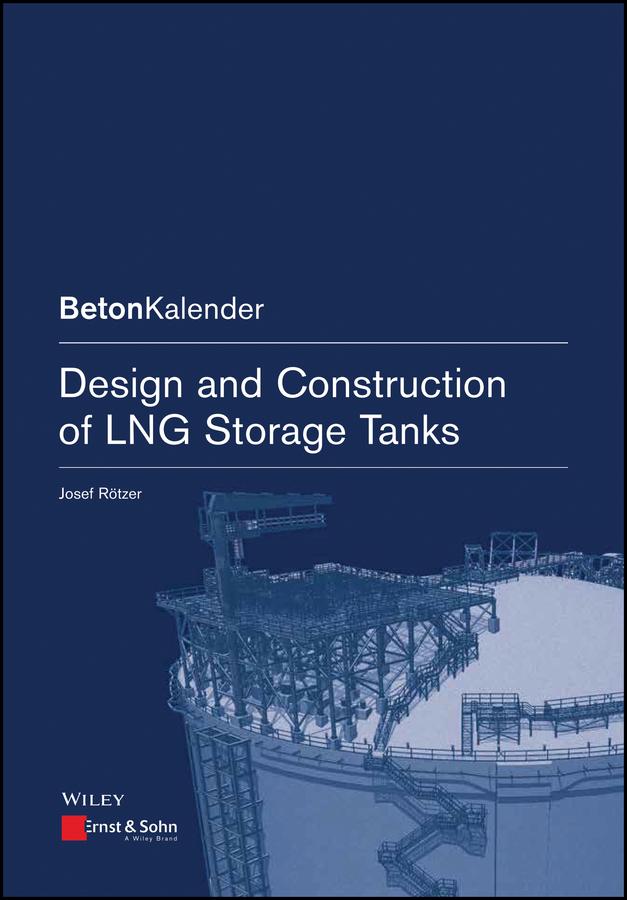
This book provides an overview of the state of the art in the design and construction of liquefied natural gas (LNG) tanks. Since the topic is very extensive and complex, an introduction to all aspects is provided, e.g. requirements and design for operating conditions, thermal design, hydrostatic and pneumatic tests, soil surveys and permissible settlement, modelling of and calculations for the concrete structure, and the actions due to fire, explosion and impact. Dynamic analysis and the theory of sloshing liquid are also presented.
In order to enable transport over long distances and oceans (and hence create an economic and political alternative to pipelines) , the gas is liquefied, which is accompanied by a considerable reduction in volume, and then transported by ship. Thus, at international ports, many LNG tanks are required for temporary storage and further use. The trend towards smaller liquefaction and regasification plants with associated storage tanks for marine fuel applications has attracted new players in this market who often do not yet have the necessary experience and technical expertise. It is not sufficient to refer to all existing technical standards when defining consistent state-of-the-art specifications and requirements.
The switch to European standardisation has made it necessary to revise and adapt existing national codes to match European standards. Technical committees at national and international level have begun their work of updating and completing the EN 14620 series.
In the USA, too, the corresponding regulations are also being updated. The revision of American Concrete Institute standard ACI 376 Requirements for Design and Construction of Concrete Structures for the Containment of Refrigerated Liquefied Gases, first published in 2011, will be completed in the spring of 2019, and the final version, published in autumn 2019.
This book provides an overview of the state of the art in the design and construction of liquefied natural gas (LNG) tanks. Since the topic is very extensive and complex, an introduction to all aspects is provided, e.g. requirements and design for operating conditions, thermal design, hydrostatic and pneumatic tests, soil surveys and permissible settlement, modelling of and calculations for the concrete structure, and the actions due to fire, explosion and impact. Dynamic analysis and the theory of sloshing liquid are also presented.
Pay easily by card, Klarna, Apple Pay or Google Pay. Not happy? You always have a 14-day money-back guarantee. Read more in our terms. If you have any questions, email us at hello@memmo.org.
Memmo makes studying easier – wherever you are in the world. We bring your course books and smart study tools together in one place: summaries, quizzes, podcasts and flashcards. Plus Ted, your study buddy who answers anything you wonder. Over 50,000 students already study here – built to help you learn faster and stress less.