
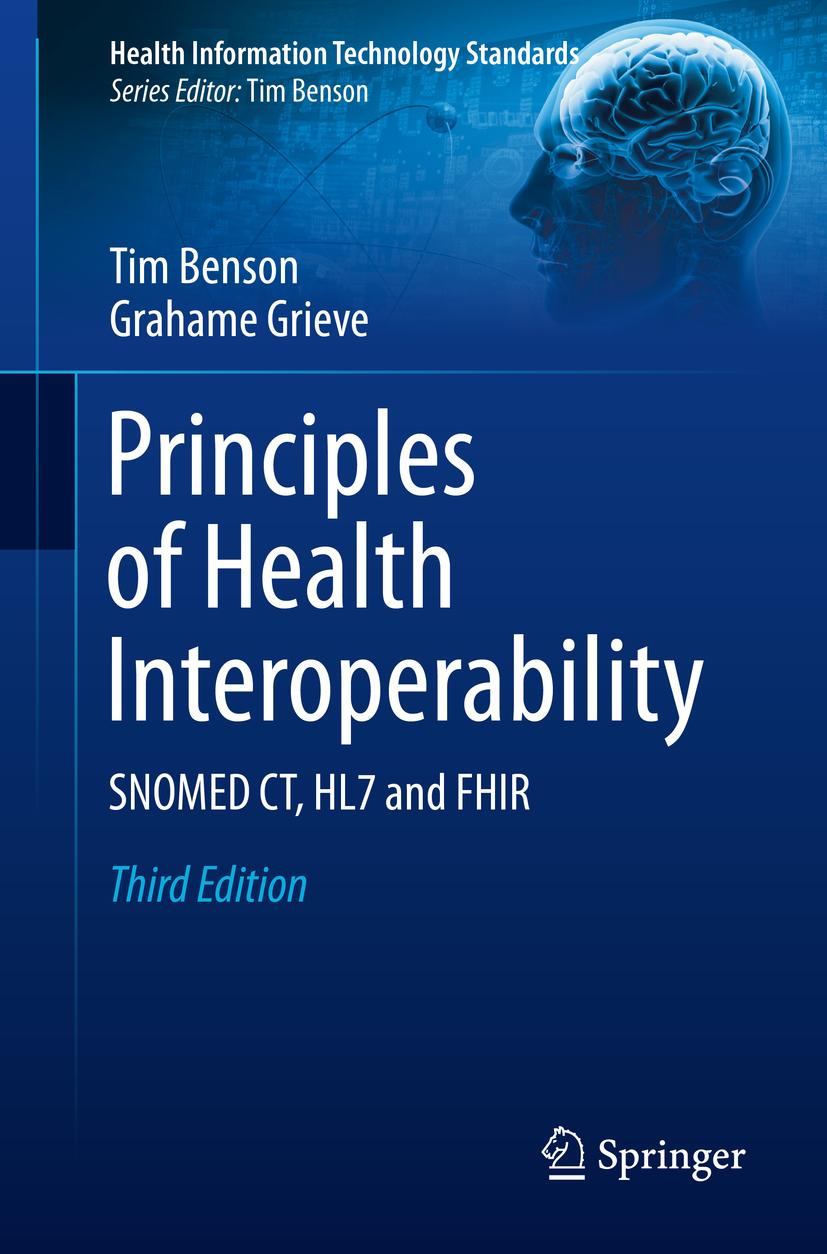
This book provides an introduction to health interoperability and the main standards used. Health interoperability delivers health information where and when it is needed. Everybody stands to gain from safer more soundly based decisions and less duplication, delays, waste and errors.
The third edition of Principles of Health Interoperability includes a new part on FHIR (Fast Health Interoperability Resources), the most important new health interoperability standard for a generation. FHIR combines the best features of HL7’s v2, v3 and CDA while leveraging the latest web standards and a tight focus on implementability. FHIR can be implemented at a fraction of the price of existing alternatives and is well suited for use in mobile phone apps, cloud communications and EHRs.
The book is organised into four parts. The first part covers the principles of health interoperability, why it matters, why it is hard and why models are an important part of the solution. The second part covers clinical terminology and SNOMED CT. The third part covers the main HL7 standards: v2, v3, CDA and IHE XDS. The new fourth part covers FHIR and has been contributed by Grahame Grieve, the original FHIR chief.Pay easily by card, Klarna, Apple Pay or Google Pay. Not happy? You always have a 14-day money-back guarantee. Read more in our terms. If you have any questions, email us at hello@memmo.org.
Memmo makes studying easier – wherever you are in the world. We bring your course books and smart study tools together in one place: summaries, quizzes, podcasts and flashcards. Plus Ted, your study buddy who answers anything you wonder. Over 50,000 students already study here – built to help you learn faster and stress less.