
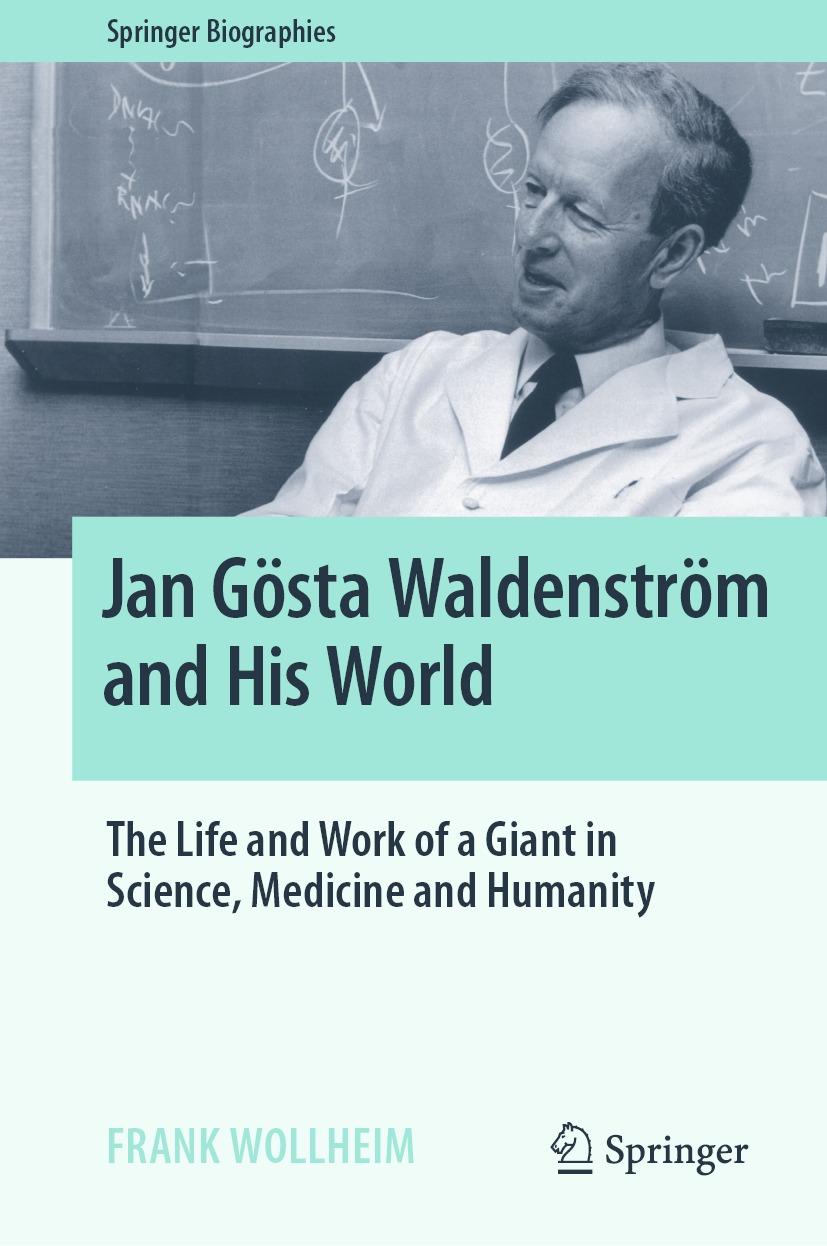
Jan Waldenström (1906-1996) was the leading Swedish internist of the twentieth century. The first chapter of the book presents his remarkable family including five generations of physicians. Born in Stockholm, we follow JW to medical school at Uppsala University during 1924–33. In 1934–5, he spent a year in the laboratory of Nobel Laureate Hans Fischer in Munich. In 1937, he defended a landmark thesis on acute intermittent porphyria. As “Docent” (assistant professor) in Uppsala, he discovered two new diseases in 1943, one of which was macroglobulinemia. In 1944–5, he spent 7 months in the US commissioned by the Swedish Health Board. This started friendships and interactions with leading colleagues and scientists. With time, JW fostered a worldwide network of contacts and became a most influential international authority. But this was just the beginning.
The book follows Waldenström's remarkable career including his description of chronic active hepatitis as a new disease and the carcinoid syndrome. Among his many other significant achievements were the introduction of nuclear medicine in Sweden and his pioneering the concept of poly- and monoclonal gammopathies. His legacy is emphasized by Waldenström lectures, Waldenström Prizes, and by the International Waldenström’s Macroglobulinemia Foundation, IWMF, and the Bing Center for Waldenström’s macroglobulinemia at the Dana Farber Institute of Cancer Institute of the Harvard University in Boston. And now, not least, by this comprehensive biography.
Pay easily by card, Klarna, Apple Pay or Google Pay. Not happy? You always have a 14-day money-back guarantee. Read more in our terms. If you have any questions, email us at hello@memmo.org.
Memmo makes studying easier – wherever you are in the world. We bring your course books and smart study tools together in one place: summaries, quizzes, podcasts and flashcards. Plus Ted, your study buddy who answers anything you wonder. Over 50,000 students already study here – built to help you learn faster and stress less.