
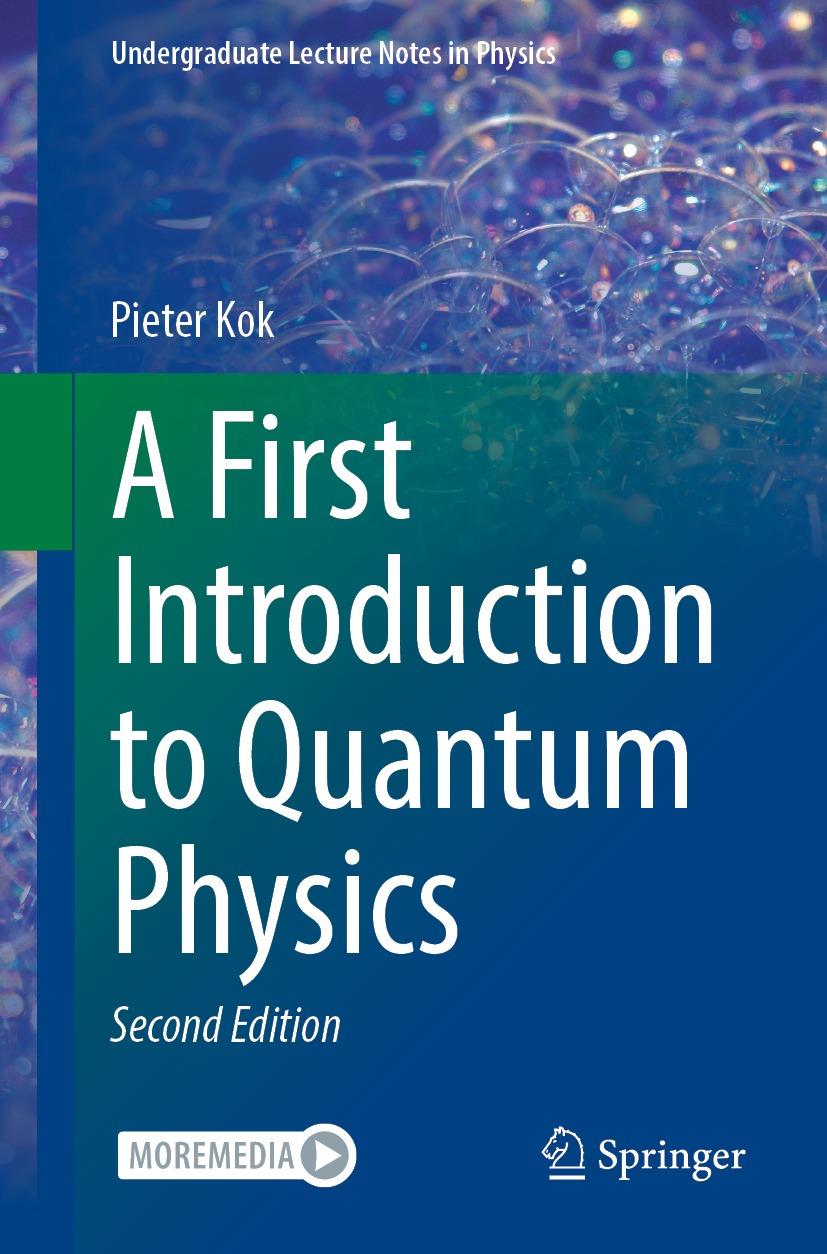
In this undergraduate textbook, now in its 2nd edition, the author develops the quantum theory from first principles based on very simple experiments: a photon traveling through beam splitters to detectors, an electron moving through magnetic fields, and an atom emitting radiation. From the physical description of these experiments follows a natural mathematical description in terms of matrices and complex numbers.
The first part of the book examines how experimental facts force us to let go of some deeply held preconceptions and develops this idea into a description of states, probabilities, observables, and time evolution. The quantum mechanical principles are illustrated using applications such as gravitational wave detection, magnetic resonance imaging, atomic clocks, scanning tunneling microscopy, and many more. The first part concludes with an overview of the complete quantum theory.
The second part of the book covers more advanced topics, including the concept ofentanglement, the process of decoherence or how quantum systems become classical, quantum computing and quantum communication, and quantum particles moving in space. Here, the book makes contact with more traditional approaches to quantum physics. The remaining chapters delve deeply into the idea of uncertainty relations and explore what the quantum theory says about the nature of reality.
The book is an ideal accessible introduction to quantum physics, tested in the classroom, with modern examples and plenty of end-of-chapter exercises.
Pay easily by card, Klarna, Apple Pay or Google Pay. Not happy? You always have a 14-day money-back guarantee. Read more in our terms. If you have any questions, email us at hello@memmo.org.
Memmo makes studying easier – wherever you are in the world. We bring your course books and smart study tools together in one place: summaries, quizzes, podcasts and flashcards. Plus Ted, your study buddy who answers anything you wonder. Over 50,000 students already study here – built to help you learn faster and stress less.