
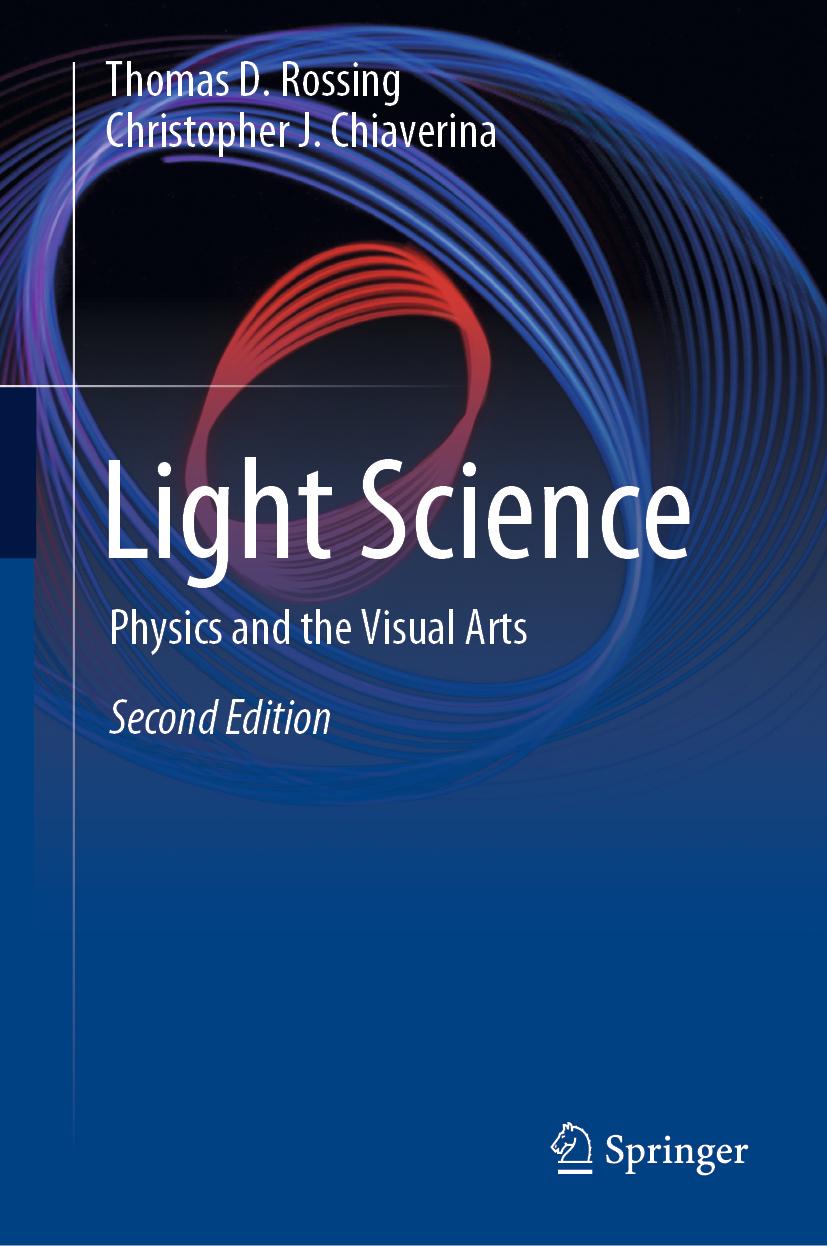
What is the nature of light? How does an artist’s selection and use of colorants determine how we experience a work of art? What can visual illusions tell us about the nature of perception? In what ways do the laws of optics manifest themselves in the visual arts?
In this fully revised edition of the classic textbook, Rossing and Chiaverina present the science of light – that is, the science behind what and how we see. Their approach emphasizes phenomena rather than mathematical theories, and the joy of discovery rather than the drudgery of derivations – the opposite of “heavy science”.
The text explores such topics as: the effects of mirrors, lenses, and prisms on light and color; the physiology of the eye and the nature of color vision; the use and effect of color in the visual arts; the different kinds of sources of light; optical data storage technology; photography and holography; color in printing and painting; the applications of optics in astronomy, medicine, and communications; and computer imaging and processing. It includes numerous problems, questions for discussion, and suggestions for simple experiments to support interactive learning.
This updated edition contains a wealth of new full-color artwork, and information on the latest developments in light source and display technologies. Requiring no prior knowledge of physics, it will appeal to students and any reader interested in the relationship between science and the visual arts.
Pay easily by card, Klarna, Apple Pay or Google Pay. Not happy? You always have a 14-day money-back guarantee. Read more in our terms. If you have any questions, email us at hello@memmo.org.
Memmo makes studying easier – wherever you are in the world. We bring your course books and smart study tools together in one place: summaries, quizzes, podcasts and flashcards. Plus Ted, your study buddy who answers anything you wonder. Over 50,000 students already study here – built to help you learn faster and stress less.