
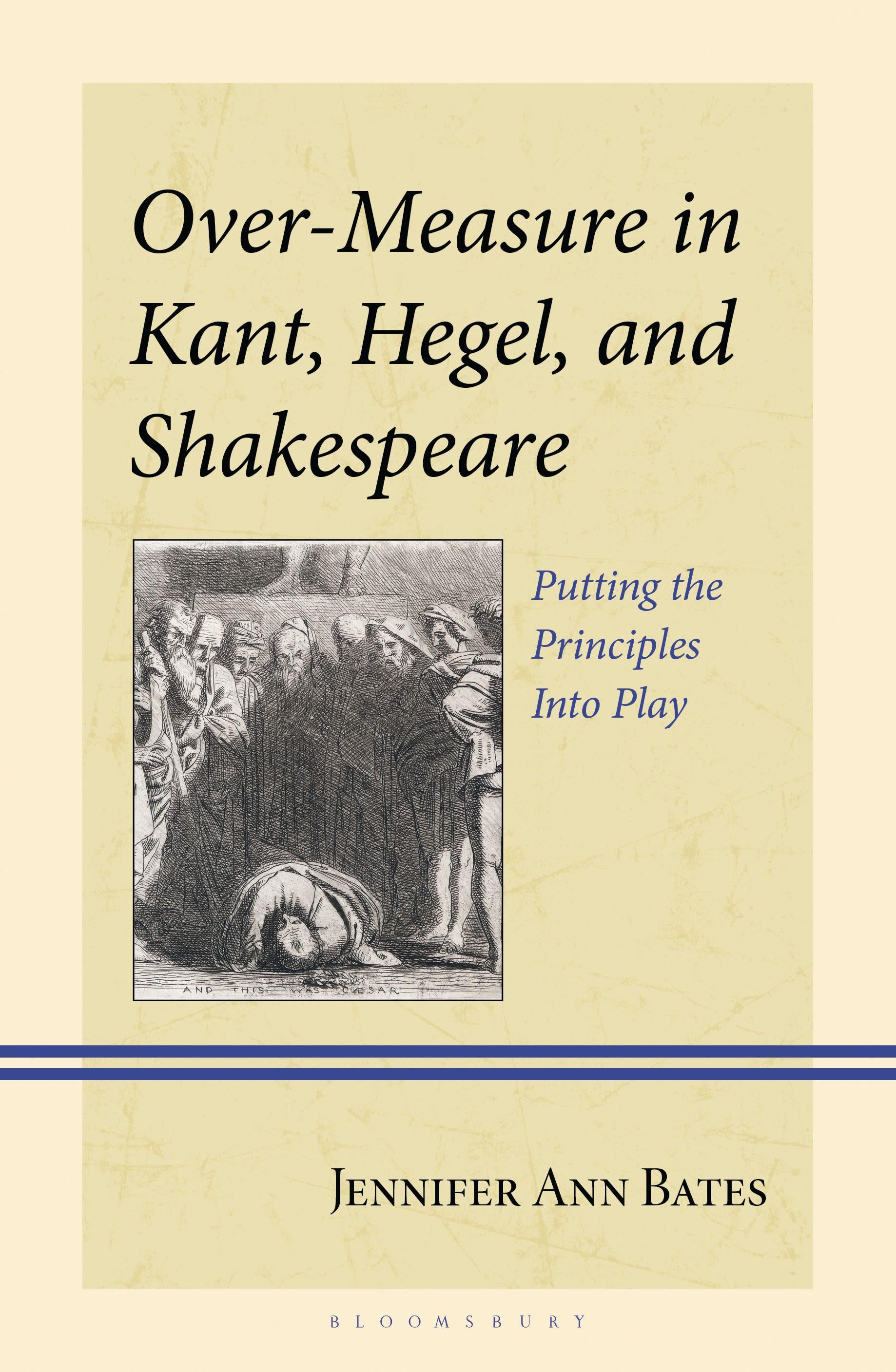
In Over-Measure in Kant, Hegel, and Shakespeare: Putting the Principles Into Play, four Shakespeare plays become the experiential-dramatic playground where operations of “principled virtues” and their informing categories are meticulously tested.
Jennifer Ann Bates begins with Hegel's logic of measure and Shakespeare's Measure for Measure, showing essential measure is indeterminable. She then combines Kant's Pure Principles of the Understanding with Shakespearean Roman tragedy, exploring principles of measure through over-measure. Bookended by Hegel's Phenomenology of Spirit, she investigates over-measures of quantity in Antony and Cleopatra, quality in Titus Andronicus, and relation and modality in Julius Caesar.
She turns to Kant for epistemic measures that make experience possible, highlighting his warnings against exceeding those limits. Putting Kant's Principles into play produces “principled virtues,” which are epistemic principles made practical and differ from Kant's Doctrine of Virtues, not just from Aristotle's virtues. Read through Shakespeare's plays, principled virtues are tragic: they miss the mark, and they are executed in both senses. The reason is that their over-measures are not grasped dialectically. The author finds a solution in Hegel's Phenomenology of Spirit, which she calls his book of over-measures. In it, Hegel reveals the necessity of overmeasures in experience, thus providing the measure for measure.
Jennifer Ann Bates begins with Hegel's logic of measure and Shakespeare's Measure for Measure, showing essential measure is indeterminable. She then combines Kant's Pure Principles of the Understanding with Shakespearean Roman tragedy, exploring principles of measure through over-measure. Bookended by Hegel's Phenomenology of Spirit, she investigates over-measures of quantity in Antony and Cleopatra, quality in Titus Andronicus, and relation and modality in Julius Caesar.
She turns to Kant for epistemic measures that make experience possible, highlighting his warnings against exceeding those limits. Putting Kant's Principles into play produces “principled virtues,” which are epistemic principles made practical and differ from Kant's Doctrine of Virtues, not just from Aristotle's virtues. Read through Shakespeare's plays, principled virtues are tragic: they miss the mark, and they are executed in both senses. The reason is that their over-measures are not grasped dialectically. The author finds a solution in Hegel's Phenomenology of Spirit, which she calls his book of over-measures. In it, Hegel reveals the necessity of overmeasures in experience, thus providing the measure for measure.
Pay easily by card, Klarna, Apple Pay or Google Pay. Not happy? You always have a 14-day money-back guarantee. Read more in our terms. If you have any questions, email us at hello@memmo.org.
Memmo makes studying easier – wherever you are in the world. We bring your course books and smart study tools together in one place: summaries, quizzes, podcasts and flashcards. Plus Ted, your study buddy who answers anything you wonder. Over 50,000 students already study here – built to help you learn faster and stress less.