
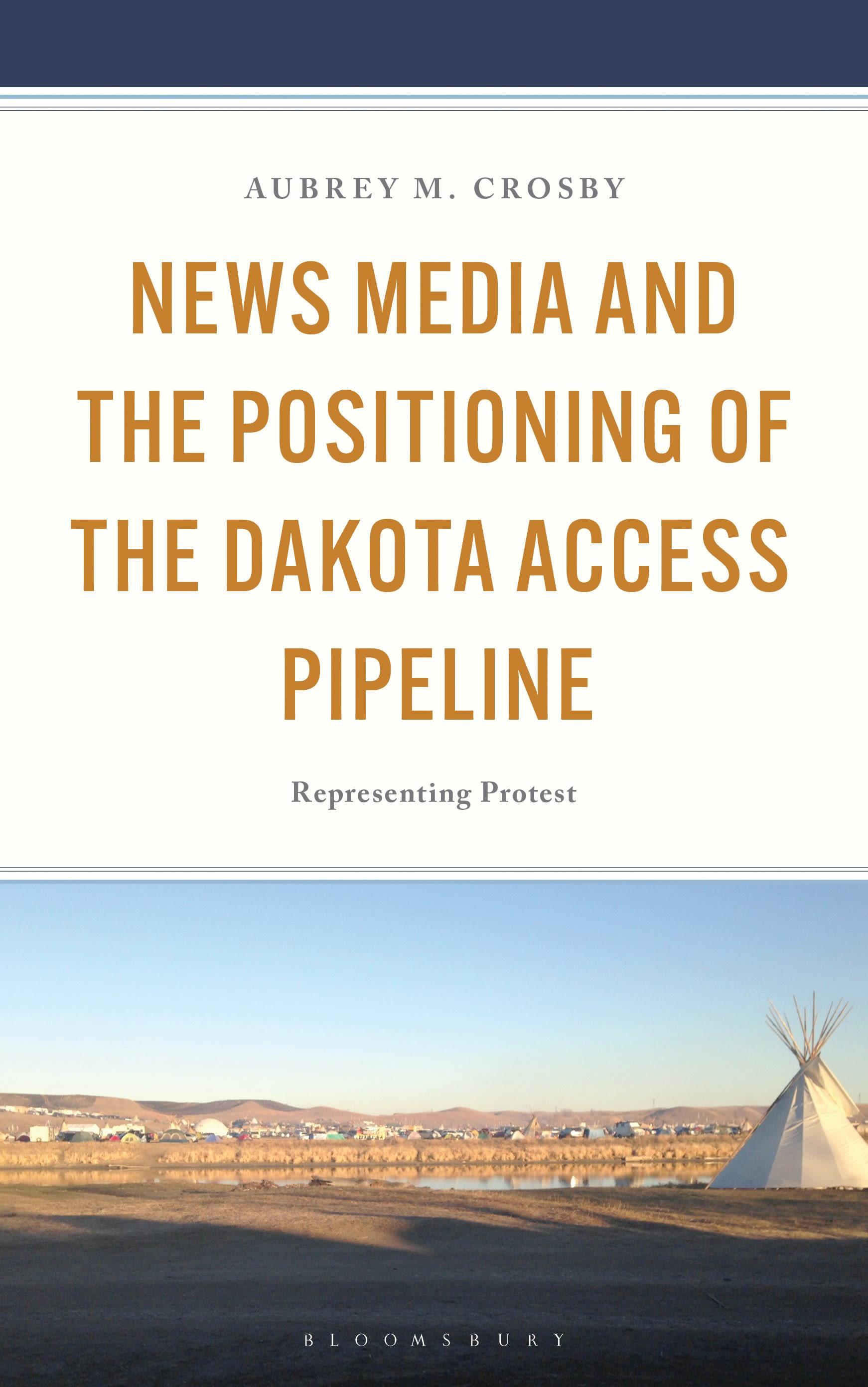
In News Media and the Positioning of the Dakota Access Pipeline: Representing Protest, Aubrey M. Crosby examines the structural and institutional forces governing the socialized practices of news production to provide a constructive critique of how news media frame events and participants in their protest coverage.
Crosby utilizes original data and the frameworks of critical discourse analysis, systemic functional linguistics, and the protest paradigm to perform critical analysis of mainstream news reporting of the Dakota Access Pipeline (DAPL) protests in 2016. She argues that news media significantly reduced the scope of the movement and (re)framed the reality of the #NoDAPL protests by fixating only on select key events and by painting participants as a collective monolith of “protestors,” a functional term which highlights their civil disobedience and erases their individual identities.
Though journalists may have had the opportunity and means to engage more critically with existing discourses, especially those surrounding Indigenous and Tribal sovereignty, mainstream reporting made little effort, if any, to do so. Through rigorous analysis, Crosby demonstrates how “protestors” were aligned with negative actions associated with emotional and destructive intent and juxtaposed with law enforcement, whose aggressive and ethically ambiguous actions were reframed as attempts to maintain law and order. Ultimately, by identifying and drawing attention to both problematic and productive practices of coverage, this work promotes constructive change regarding how power is wielded, maintained, and produced in organizations and in the social realm.
Crosby utilizes original data and the frameworks of critical discourse analysis, systemic functional linguistics, and the protest paradigm to perform critical analysis of mainstream news reporting of the Dakota Access Pipeline (DAPL) protests in 2016. She argues that news media significantly reduced the scope of the movement and (re)framed the reality of the #NoDAPL protests by fixating only on select key events and by painting participants as a collective monolith of “protestors,” a functional term which highlights their civil disobedience and erases their individual identities.
Though journalists may have had the opportunity and means to engage more critically with existing discourses, especially those surrounding Indigenous and Tribal sovereignty, mainstream reporting made little effort, if any, to do so. Through rigorous analysis, Crosby demonstrates how “protestors” were aligned with negative actions associated with emotional and destructive intent and juxtaposed with law enforcement, whose aggressive and ethically ambiguous actions were reframed as attempts to maintain law and order. Ultimately, by identifying and drawing attention to both problematic and productive practices of coverage, this work promotes constructive change regarding how power is wielded, maintained, and produced in organizations and in the social realm.
Pay easily by card, Klarna, Apple Pay or Google Pay. Not happy? You always have a 14-day money-back guarantee. Read more in our terms. If you have any questions, email us at hello@memmo.org.
Memmo makes studying easier – wherever you are in the world. We bring your course books and smart study tools together in one place: summaries, quizzes, podcasts and flashcards. Plus Ted, your study buddy who answers anything you wonder. Over 50,000 students already study here – built to help you learn faster and stress less.