
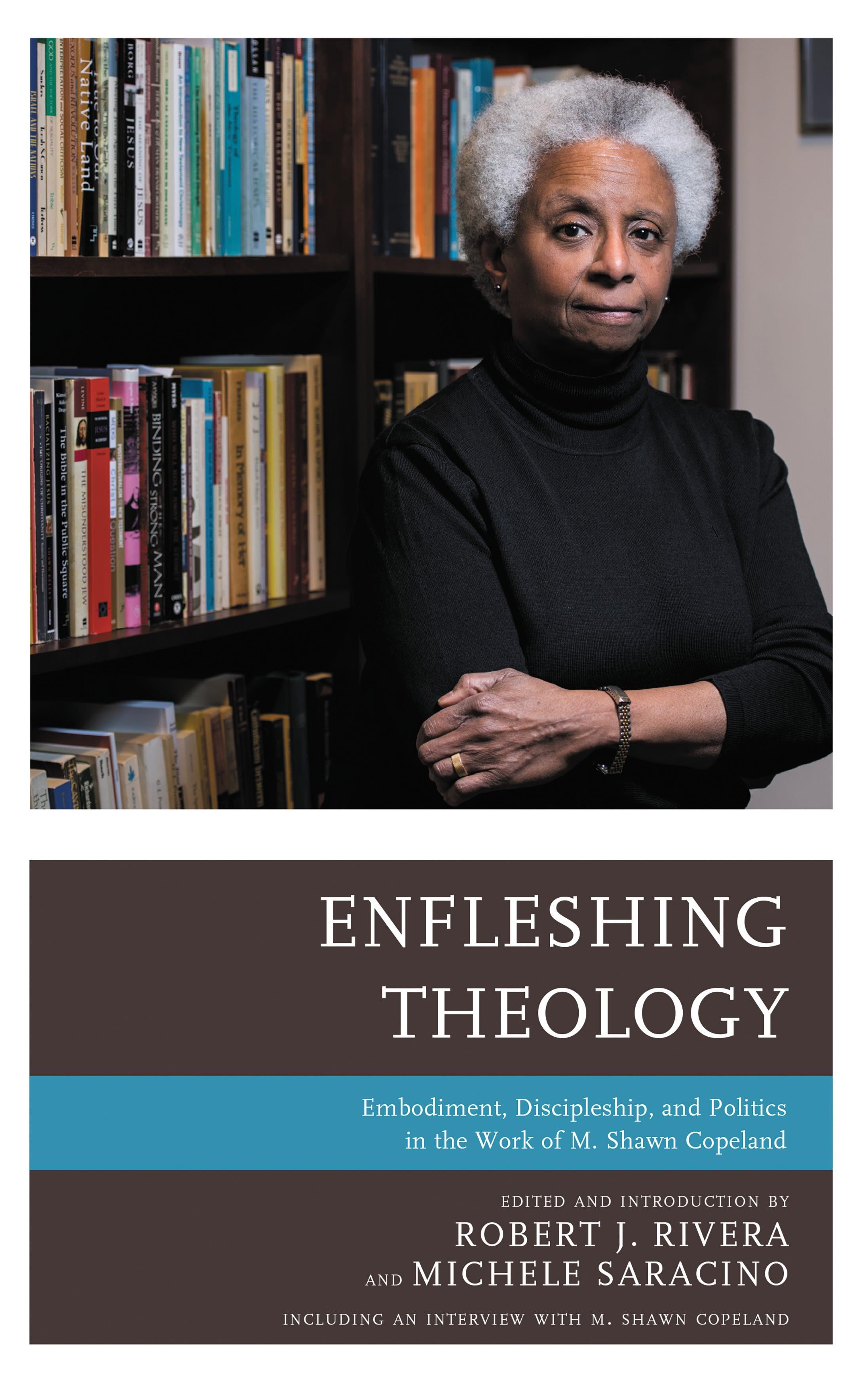
Enfleshing Theology
Author: M. Shawn Copeland, Christine Firer Hinze, Bryan N. Massingale, Susan Abraham, Willie James Jennings, Nancy Pineda-Madrid, Katie G. Cannon, Roberto S. Goizueta, Karen Teel, Eboni Marshall Turman, Laurie Cassidy, Michele Saracino, Shawnee M. Daniels-Sykes, Deirdre Dempsey, Susan L. Gray, Mary Ann Hinsdale, Maureen O'Connell, Stephen G. Ray, Kathleen Williams, RSM, Robert J. Rivera
Publisher: Bloomsbury Publishing
Edition: 1
Published date: 2018
ISBN: 9781978704053
Enfleshing Theology honors and engages the life work of M. Shawn Copeland, whose theology is groundbreaking and prophetic, traversing the fields of Catholic Theology, Black Theology, Womanist Thought, and Semiotics. The book opens with a brief introduction, and then moves to an interview with Copeland, which connects her theology to her life stories. The conversation with Copeland also provides a backdrop to the seventeen essays that follow, extending Copeland’s theological worldview. The contributions are divided according to the following sections: embodiment, discipleship, and politics. The essays in the section entitled "Engaging Embodiment" critically reflect on the importance of embodiment in Christian theology and contemporary culture. Following Copeland’s lead, authors in this section theorize and theologize the body, particularly (but not limited to) Black women’s bodies, as a locus theologicus that reveals, mediates, and shapes the splendor and suffering reality of human existence. The next section, entitled "Engaging Discipleship," focuses on the concrete challenges of following Jesus in today’s world. The essays included in this section reflect on Copeland’s focus on Jesus’ particularity in terms of his solidarity with and for others. Discipleship is about modeling and mentoring, so scholars in this section also comment on Copeland’s contribution to teaching and pedagogy. The last section, entitled "Engaging the Political," interrogates the political implications of the theological. It is noteworthy that there are two trajectories of the political here, one is Copeland’s development of political theology through the lens of Canadian Jesuit theologian, Bernard Lonergan. The other trajectory focuses on the work of theology in contemporary art and politics. These three sections are fluid and overlap with one another. Several of the articles on embodiment speak to questions of solidarity and a few of the essays on discipleship clearly present as political. The ways in which each of the contributions in this volume overlap with each other attests to the complex nature of doing constructive theology today, and even more how Copeland’s work is at the forefront of that multi-layered, polyvalent, intersectional theological work.
Pay easily by card, Klarna, Apple Pay or Google Pay. Not happy? You always have a 14-day money-back guarantee. Read more in our terms. If you have any questions, email us at hello@memmo.org.
Memmo makes studying easier – wherever you are in the world. We bring your course books and smart study tools together in one place: summaries, quizzes, podcasts and flashcards. Plus Ted, your study buddy who answers anything you wonder. Over 50,000 students already study here – built to help you learn faster and stress less.