
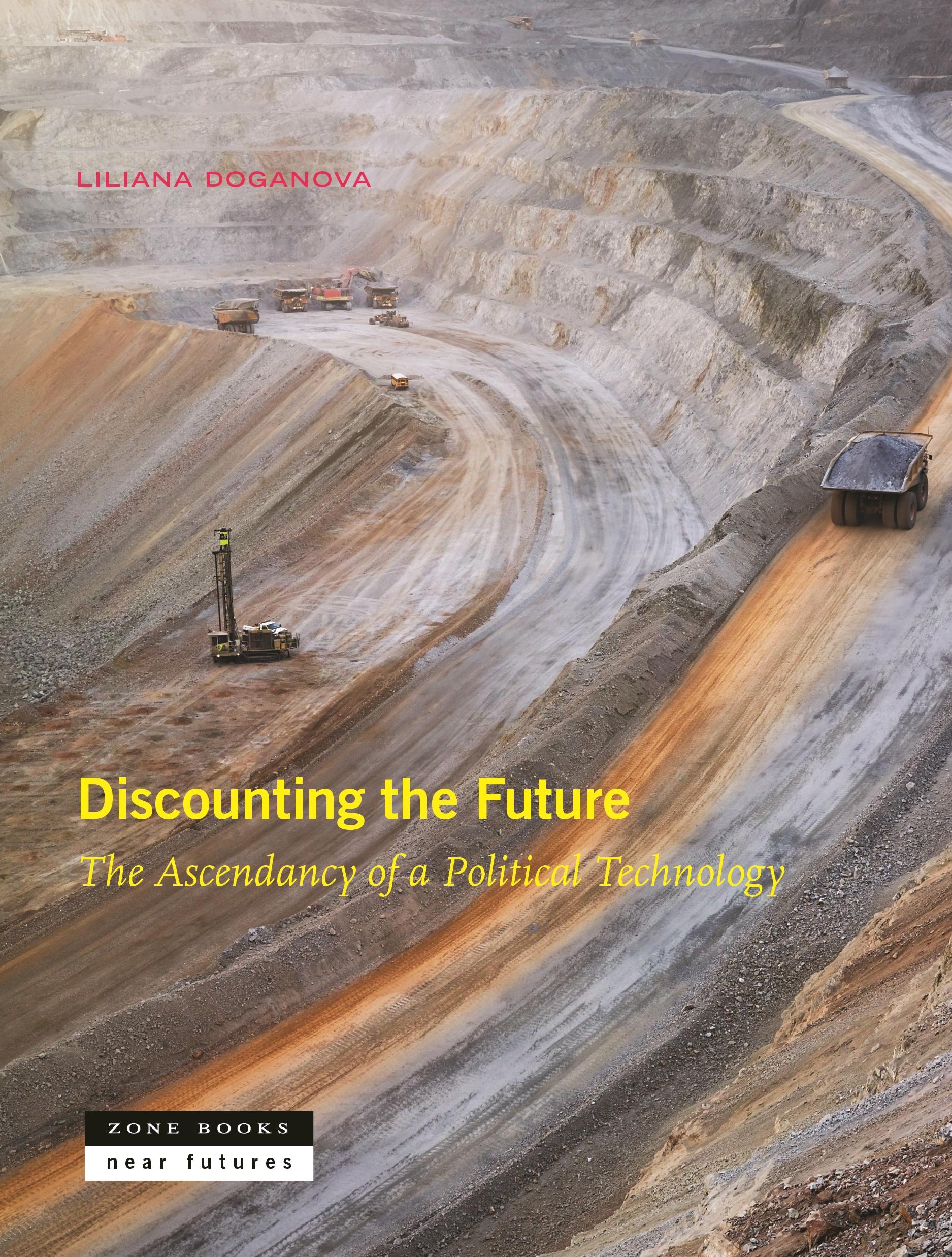
A pioneering exploration of the defining traits and contradictions of our relationship to the future through the lens of discounting
Forest fires, droughts, and rising sea levels beg a nagging question: have we lost our capacity to act on the future? Liliana Doganova’s book sheds new light on this anxious query. It argues that our relationship to the future has been trapped in the gears of a device called discounting. While its incidence remains little known, discounting has long been entrenched in market and policy practices, shaping the ways firms and governments look to the future and make decisions accordingly. Thus, a sociological account of discounting formulas has become urgent.
Discounting means valuing things through the flows of costs and benefits that they are likely to generate in the future, with these future flows being literally dis-counted as they are translated in the present. How have we come to think of the future, and of valuation, in such terms? Building on original empirical research in the historical sociology of discounting, Doganova takes us to some of the sites and moments in which discounting took shape and gained momentum: valuation of European forests in the eighteenth and nineteenth centuries; economic theories devised in the early 1900s; debates over business strategies in the postwar era; investor-state disputes over the nationalization of natural resources; and drug development in the biopharmaceutical industry today. Weaving these threads together, the book pleads for an understanding of discounting as a political technology, and of the future as a contested domain.
Pay easily by card, Klarna, Apple Pay or Google Pay. Not happy? You always have a 14-day money-back guarantee. Read more in our terms. If you have any questions, email us at hello@memmo.org.
Memmo makes studying easier – wherever you are in the world. We bring your course books and smart study tools together in one place: summaries, quizzes, podcasts and flashcards. Plus Ted, your study buddy who answers anything you wonder. Over 50,000 students already study here – built to help you learn faster and stress less.