
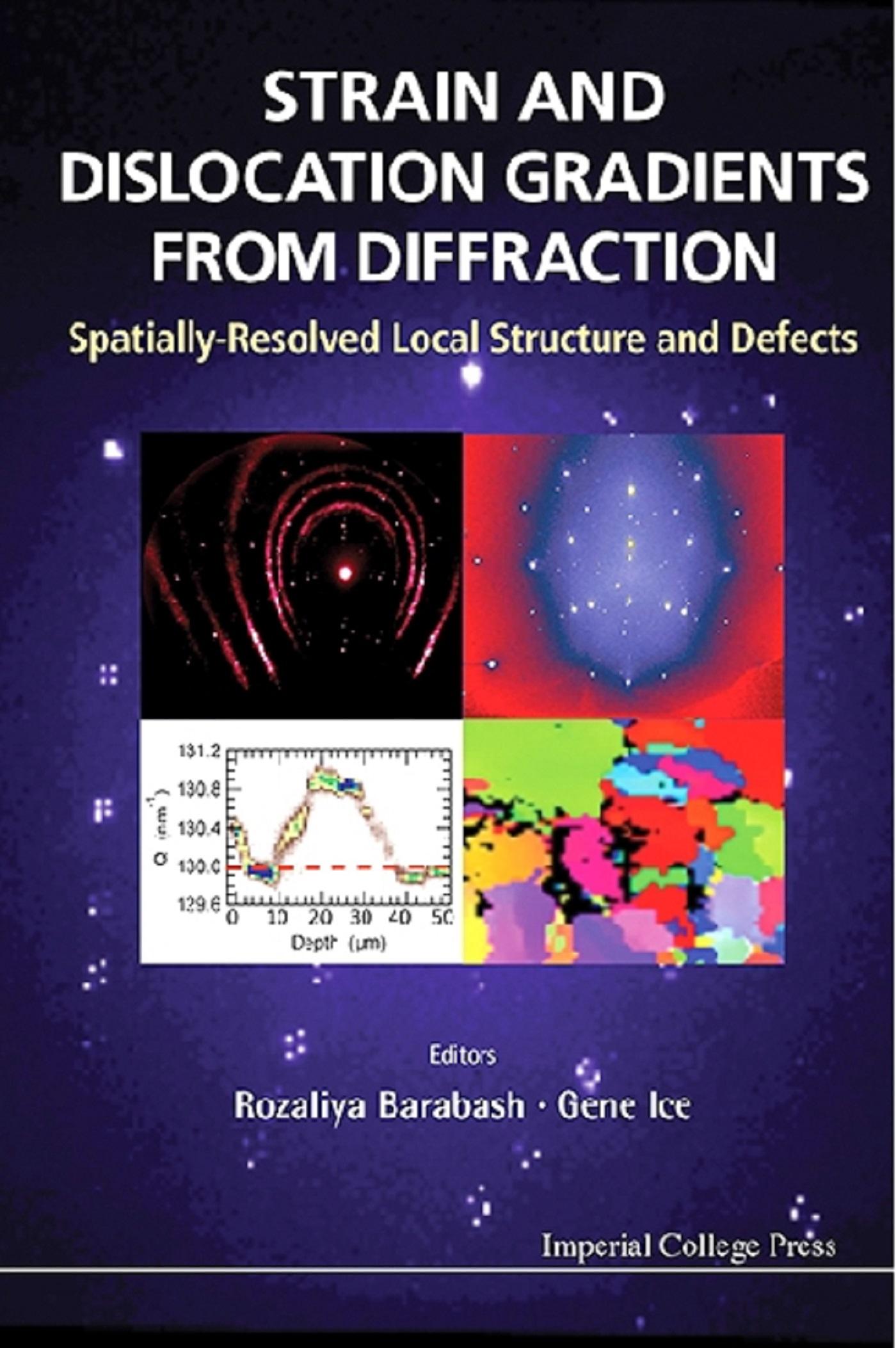
This book highlights emerging diffraction studies of strain and dislocation gradients with mesoscale resolution, which is currently a focus of research at laboratories around the world. While ensemble-average diffraction techniques are mature, grain and subgrain level measurements needed to understand real materials are just emerging. In order to understand the diffraction signature of different defects, it is necessary to understand the distortions created by the defects and the corresponding changes in the reciprocal space of the non-ideal crystals.Starting with a review of defect classifications based on their displacement fields, this book then provides connections between different dislocation arrangements, including geometrically necessary and statistically stored dislocations, and other common defects and the corresponding changes in the reciprocal space and diffraction patterns. Subsequent chapters provide an overview of microdiffraction techniques developed during the last decade to extract information about strain and dislocation gradients. X-ray microdiffraction is a particularly exciting application compared with alternative probes of local crystalline structure, orientation and defect density, because it is inherently non-destructive and penetrating.
Pay easily by card, Klarna, Apple Pay or Google Pay. Not happy? You always have a 14-day money-back guarantee. Read more in our terms. If you have any questions, email us at hello@memmo.org.
Memmo makes studying easier – wherever you are in the world. We bring your course books and smart study tools together in one place: summaries, quizzes, podcasts and flashcards. Plus Ted, your study buddy who answers anything you wonder. Over 50,000 students already study here – built to help you learn faster and stress less.
You might also like
Buy the book0