
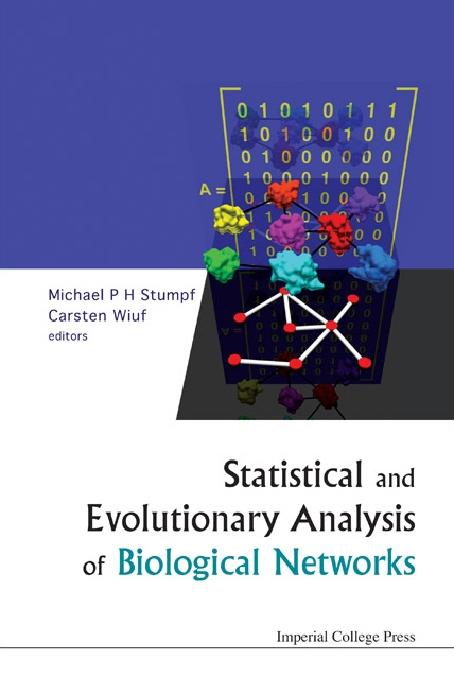
Networks provide a very useful way to describe a wide range of different data types in biology, physics and elsewhere. Apart from providing a convenient tool to visualize highly dependent data, networks allow stringent mathematical and statistical analysis.In recent years, much progress has been achieved to interpret various types of biological network data such as transcriptomic, metabolomic and protein interaction data as well as epidemiological data. Of particular interest is to understand the organization, complexity and dynamics of biological networks and how these are influenced by network evolution and functionality.This book reviews and explores statistical, mathematical and evolutionary theory and tools in the understanding of biological networks. The book is divided into comprehensive and self-contained chapters, each of which focuses on an important biological network type, explains concepts and theory and illustrates how these can be used to obtain insight into biologically relevant processes and questions. There are chapters covering metabolic, transcriptomic, protein interaction and epidemiological networks as well as chapters that deal with theoretical and conceptual material. The authors, who contribute to the book, are active, highly regarded and well-known in the network community.
Pay easily by card, Klarna, Apple Pay or Google Pay. Not happy? You always have a 14-day money-back guarantee. Read more in our terms. If you have any questions, email us at hello@memmo.org.
Memmo makes studying easier – wherever you are in the world. We bring your course books and smart study tools together in one place: summaries, quizzes, podcasts and flashcards. Plus Ted, your study buddy who answers anything you wonder. Over 50,000 students already study here – built to help you learn faster and stress less.
You might also like
Buy the book0