
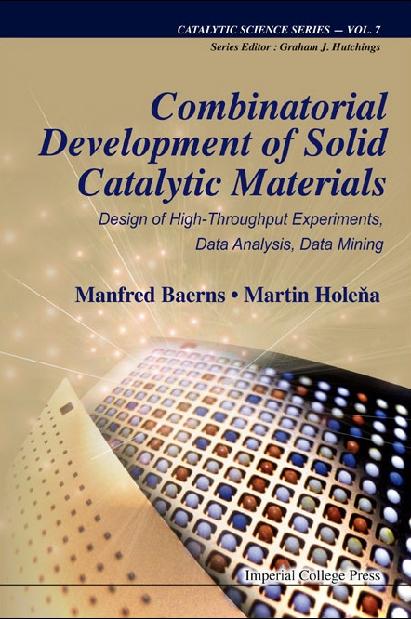
The book provides a comprehensive treatment of combinatorial development of heterogeneous catalysts. In particular, two computer-aided approaches that have played a key role in combinatorial catalysis and high-throughput experimentation during the last decade — evolutionary optimization and artificial neural networks — are described. The book is unique in that it describes evolutionary optimization in a broader context of methods of searching for optimal catalytic materials, including statistical design of experiments, as well as presents neural networks in a broader context of data analysis. It is the first book that demystifies the attractiveness of artificial neural networks, explaining its rational fundamental — their universal approximation capability. At the same time, it shows the limitations of that capability and describes two methods for how it can be improved. The book is also the first that presents two other important topics pertaining to evolutionary optimization and artificial neural networks: automatic generating of problem-tailored genetic algorithms, and tuning evolutionary algorithms with neural networks. Both are not only theoretically explained, but also well illustrated through detailed case studies.
Pay easily by card, Klarna, Apple Pay or Google Pay. Not happy? You always have a 14-day money-back guarantee. Read more in our terms. If you have any questions, email us at hello@memmo.org.
Memmo makes studying easier – wherever you are in the world. We bring your course books and smart study tools together in one place: summaries, quizzes, podcasts and flashcards. Plus Ted, your study buddy who answers anything you wonder. Over 75,000 students already study here – built to help you learn faster and stress less.
You might also like
Buy the book0