
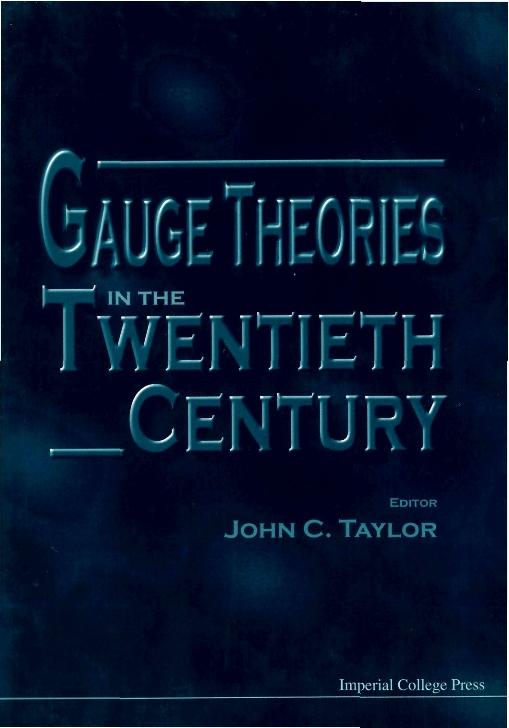
By the end of the 1970s, it was clear that all the known forces of nature (including, in a sense, gravity) were examples of gauge theories, characterized by invariance under symmetry transformations chosen independently at each position and each time. These ideas culminated with the finding of the W and Z gauge bosons (and perhaps also the Higgs boson). This important book brings together the key papers in the history of gauge theories, including the discoveries of: the role of gauge transformations in the quantum theory of electrically charged particles in the 1920s; nonabelian gauge groups in the 1950s; vacuum symmetry-breaking in the 1960s; asymptotic freedom in the 1970s. A short introduction explains the significance of the papers, and the connections between them.
Pay easily by card, Klarna, Apple Pay or Google Pay. Not happy? You always have a 14-day money-back guarantee. Read more in our terms. If you have any questions, email us at hello@memmo.org.
Memmo makes studying easier – wherever you are in the world. We bring your course books and smart study tools together in one place: summaries, quizzes, podcasts and flashcards. Plus Ted, your study buddy who answers anything you wonder. Over 50,000 students already study here – built to help you learn faster and stress less.
You might also like
Buy the book0