
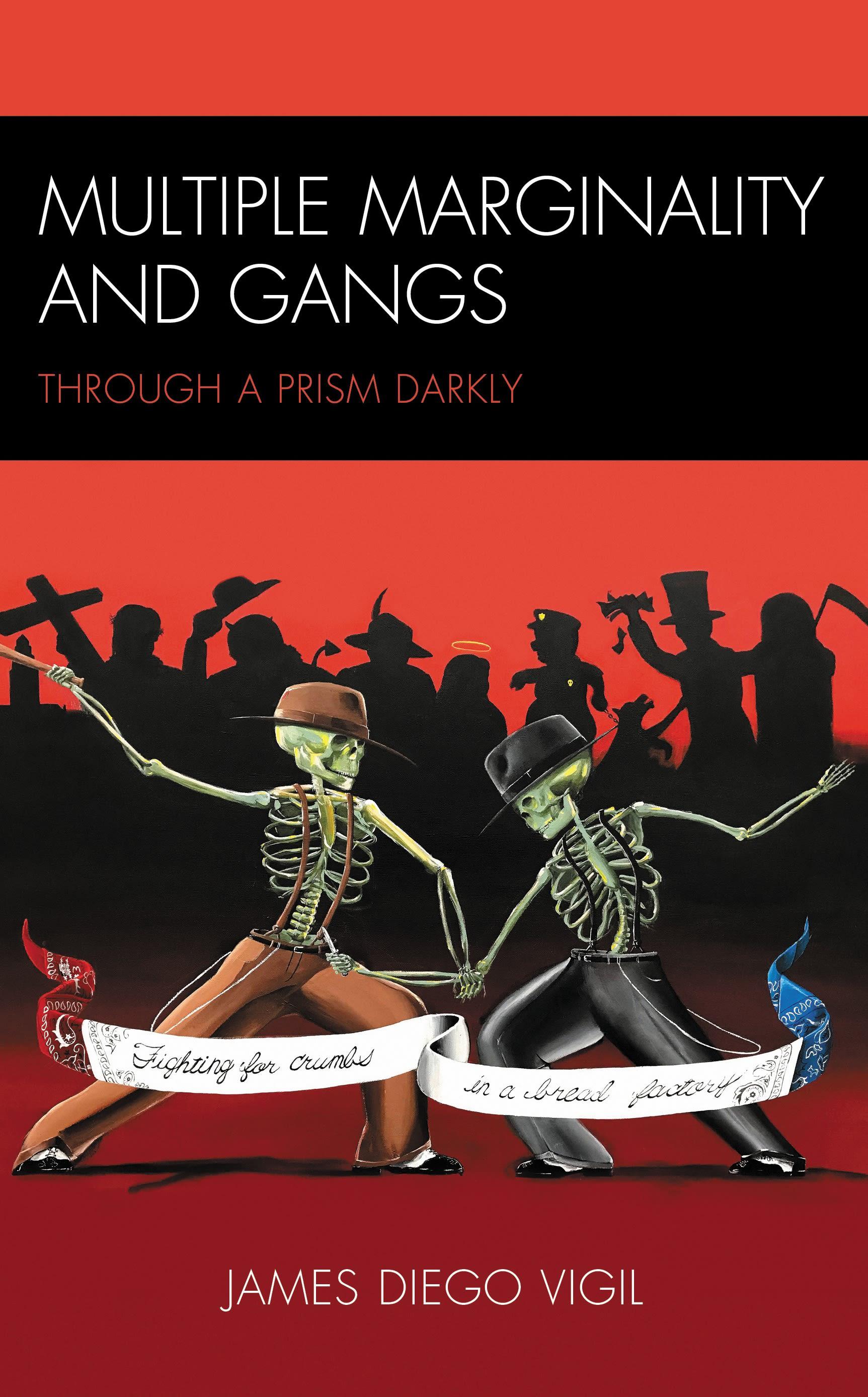
Multiple Marginality and Gangs: Through a Prism Darkly unravels the youth gang problem in a multidimensional approach that encompasses the place, status, social control, subcultural, and identity facets of urban street gangs. The power of place and the status of persons and groups are the major forces that generate the many situations and conditions that give rise to gangs. In its simplest trajectory, Multiple Marginality can be modeled as follows: place/status to street socialization to street subculture to street identity. It is the actions and reactions among them that we fathom. As we witness detrimental or absent family influence, we also observe weaker, underfunded schools that limit educators’ reach. At the same time, there has been an increase in the militarization of law enforcement to deal with the youth street populations, the heaviest hand is that of the police. There is a causal relationship between social marginalization factors and gang membership. A psychological analysis also entails how street socialization leads to a street identity. In a place and status group, the cascading effects of marginalization have certainly affected—and mostly thwarted—social control institutions.
Pay easily by card, Klarna, Apple Pay or Google Pay. Not happy? You always have a 14-day money-back guarantee. Read more in our terms. If you have any questions, email us at hello@memmo.org.
Memmo makes studying easier – wherever you are in the world. We bring your course books and smart study tools together in one place: summaries, quizzes, podcasts and flashcards. Plus Ted, your study buddy who answers anything you wonder. Over 50,000 students already study here – built to help you learn faster and stress less.