
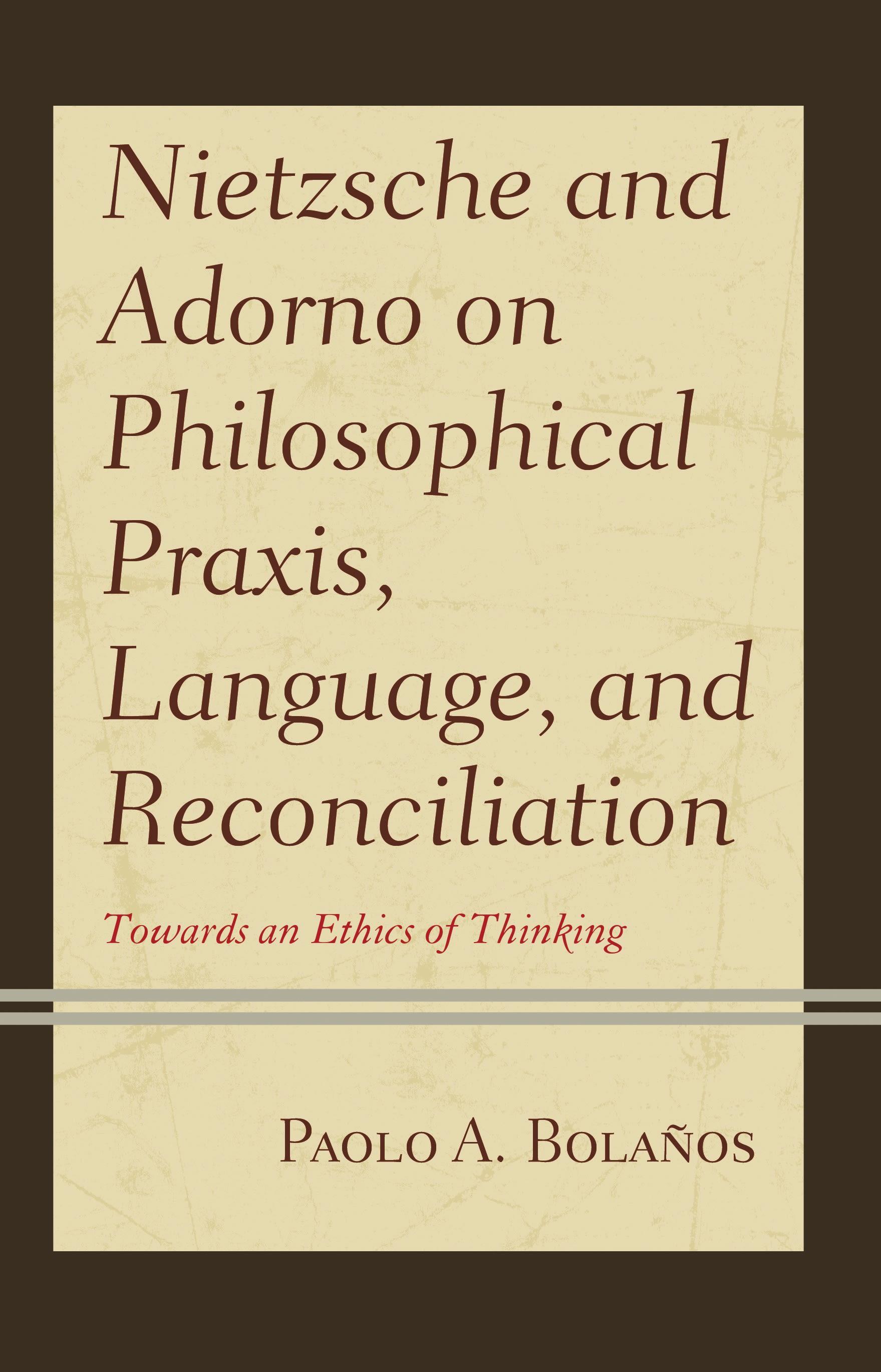
Nietzsche and Adorno on Philosophical Praxis, Language, and Reconciliation: Towards an Ethics of Thinking offers a philosophical notion of an “ethics of thinking,” a kind of thinking that is receptive to the non-identical character of the world of human and non-human objects. Paolo A. Bolaños experiments with the ideas of Friedrich Nietzsche and Theodor W. Adorno, who are presented as contemporary proponents of the Frühromantik tradition. Bolaños offers a reconstruction of the respective philosophies of language of Nietzsche and Adorno, as well as a rehearsal of their critique of metaphysics and identity thinking, in order to develop a notion of philosophical praxis that is grounded in the ethical dimension of thinking. Via Nietzsche and Adorno, Bolaños argues that thinking’s performative participation in uncertainty broadens the domain of reason, thereby also broadening our conceptual capacities and our receptivity to new possibilities of thinking. As an ethical praxis, thinking guards itself from the error of solidification, thereby opening philosophy to a reconciliatory, as opposed to domineering, reception of the world.
Pay easily by card, Klarna, Apple Pay or Google Pay. Not happy? You always have a 14-day money-back guarantee. Read more in our terms. If you have any questions, email us at hello@memmo.org.
Memmo makes studying easier – wherever you are in the world. We bring your course books and smart study tools together in one place: summaries, quizzes, podcasts and flashcards. Plus Ted, your study buddy who answers anything you wonder. Over 50,000 students already study here – built to help you learn faster and stress less.