
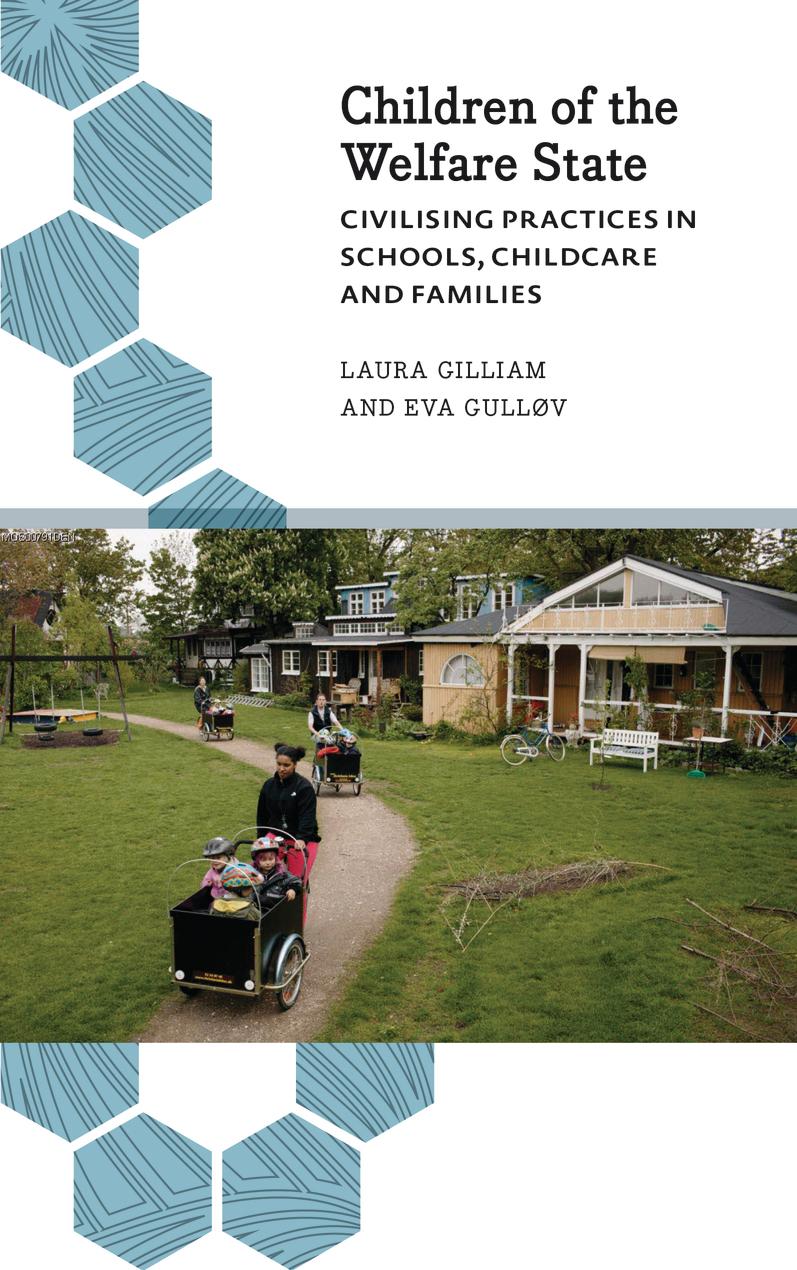
This original ethnographic study looks at how children are ‘civilised’ within child institutions, such as schools, day care centres and families, under the auspices of the welfare state.
As part of a general discussion on civilising projects and the role of state institutions, the authors focus on Denmark, a country characterised by the extent of time children use in public institutions from an early age. They look at the extraordinary amount of attention and effort put into the process of upbringing by the state, as well as the widespread co-operation in this by parents across the social spectrum.
Taking as its point of departure the sociologist Norbert Elias’ concept of civilising, Children of the Welfare State explores the ideals of civilised conduct expressed through institutional upbringing and examine how children of different age, gender, ethnicity and social backgrounds experience and react to these norms and efforts. The analysis demonstrates that welfare state institutions, though characterised by a strong egalitarian ideal, create distinctions between social groups, teach children about moral hierarchies in society and prompts them to identify as more or less civilised citizens of the state.
As part of a general discussion on civilising projects and the role of state institutions, the authors focus on Denmark, a country characterised by the extent of time children use in public institutions from an early age. They look at the extraordinary amount of attention and effort put into the process of upbringing by the state, as well as the widespread co-operation in this by parents across the social spectrum.
Taking as its point of departure the sociologist Norbert Elias’ concept of civilising, Children of the Welfare State explores the ideals of civilised conduct expressed through institutional upbringing and examine how children of different age, gender, ethnicity and social backgrounds experience and react to these norms and efforts. The analysis demonstrates that welfare state institutions, though characterised by a strong egalitarian ideal, create distinctions between social groups, teach children about moral hierarchies in society and prompts them to identify as more or less civilised citizens of the state.
Pay easily by card, Klarna, Apple Pay or Google Pay. Not happy? You always have a 14-day money-back guarantee. Read more in our terms. If you have any questions, email us at hello@memmo.org.
Memmo makes studying easier – wherever you are in the world. We bring your course books and smart study tools together in one place: summaries, quizzes, podcasts and flashcards. Plus Ted, your study buddy who answers anything you wonder. Over 50,000 students already study here – built to help you learn faster and stress less.
You might also like
Buy the book0