
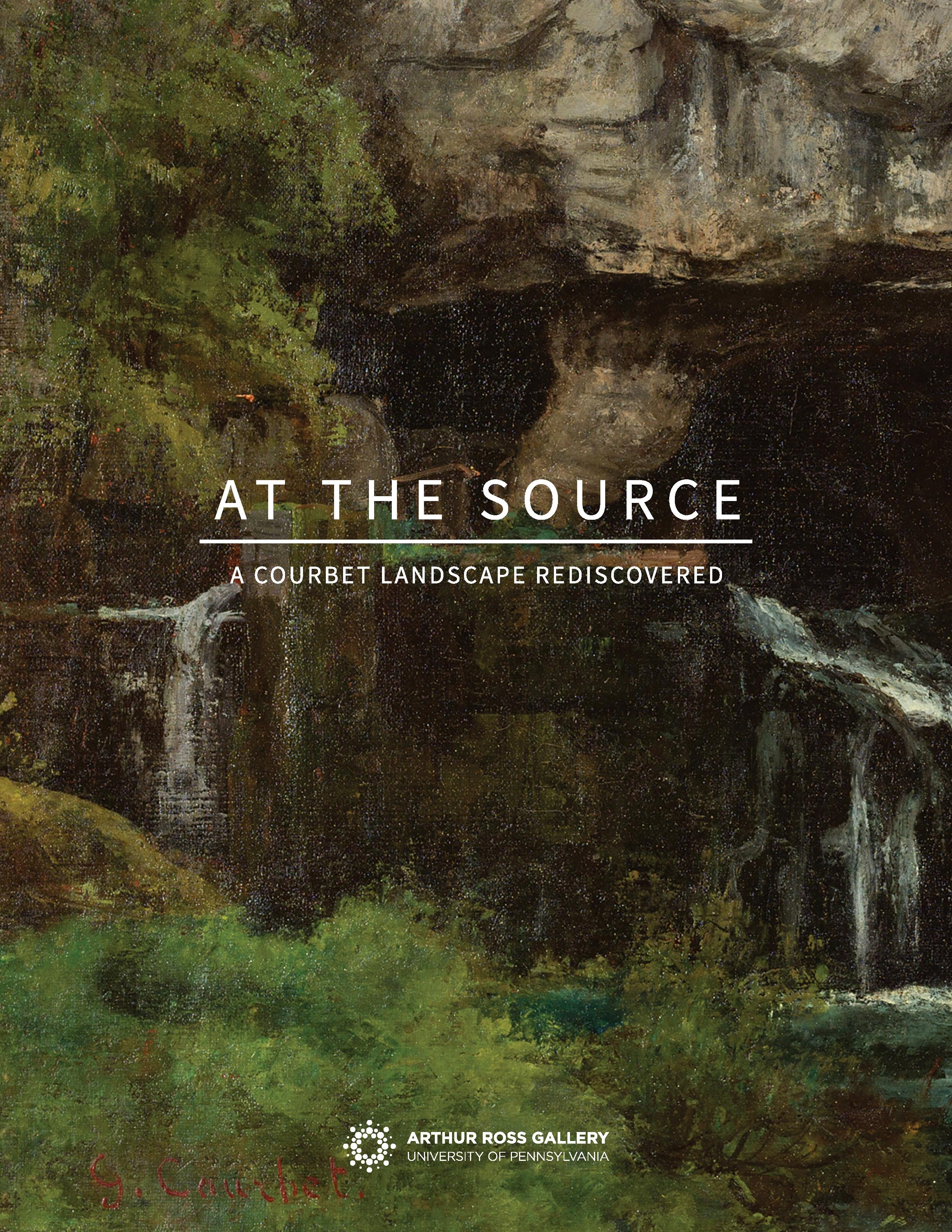
In 2016, a landscape painting of the source of the Lison river in France was discovered at the University of Pennsylvania and was immediately suspected of being the work of Gustave Courbet. A lengthy authentication process began in 2018 and the landscape has since been confirmed as his. This new discovery sparked an exhibition showcasing the infamous painter’s modern landscape practice. Titled At the Source: A Courbet Landscape Rediscovered, the exhibition is presented at the University of Pennsylvania’s Arthur Ross Gallery from February 4 to May 28, 2023. Focusing on the motifs of grottos and waterfalls in his art of the 1850s and 1860s, it highlights the rediscovered Courbet painting, not shown in public for close to 100 years, and emphasizes the process of authenticating and conserving this historic work.
Gustave Courbet (1819–1877) was a French painter who led the Realism movement of the mid nineteenth-century. Committed to painting only what he could see, he rejected academic conventions and the Romanticism of the previous generation of artists. Courbet's paintings of the late 1840s and early 1850s brought him his first recognition. They challenged tradition by depicting unidealized peasants and workers, often on a grand scale previously reserved for paintings of religious or historical subjects. Courbet's subsequent paintings offer a wide range of genres and broadened the political character of his art: landscapes, seascapes, hunting scenes, nudes, and still lifes.
This heavily illustrated catalog brings together essays by leading Courbet scholars, including Petra ten-Doesschate Chu, Aruna D’Souza, Paul Galvez, and Mary Morton, and situates Courbet’s modern landscapes within the genre of nineteenth-century plein-air painting. Contextualizing the newly discovered work in relation to other visual depictions of the site, the catalog reproduces postcards and maps as well as the few other versions of the Source of the Lison that Courbet painted, including other related subjects. The essays draw connections between Courbet’s paintings and his political activism, his interests in geology and environmentalism, and his engagement with issues of gender.
Pay easily by card, Klarna, Apple Pay or Google Pay. Not happy? You always have a 14-day money-back guarantee. Read more in our terms. If you have any questions, email us at hello@memmo.org.
Memmo makes studying easier – wherever you are in the world. We bring your course books and smart study tools together in one place: summaries, quizzes, podcasts and flashcards. Plus Ted, your study buddy who answers anything you wonder. Over 50,000 students already study here – built to help you learn faster and stress less.