
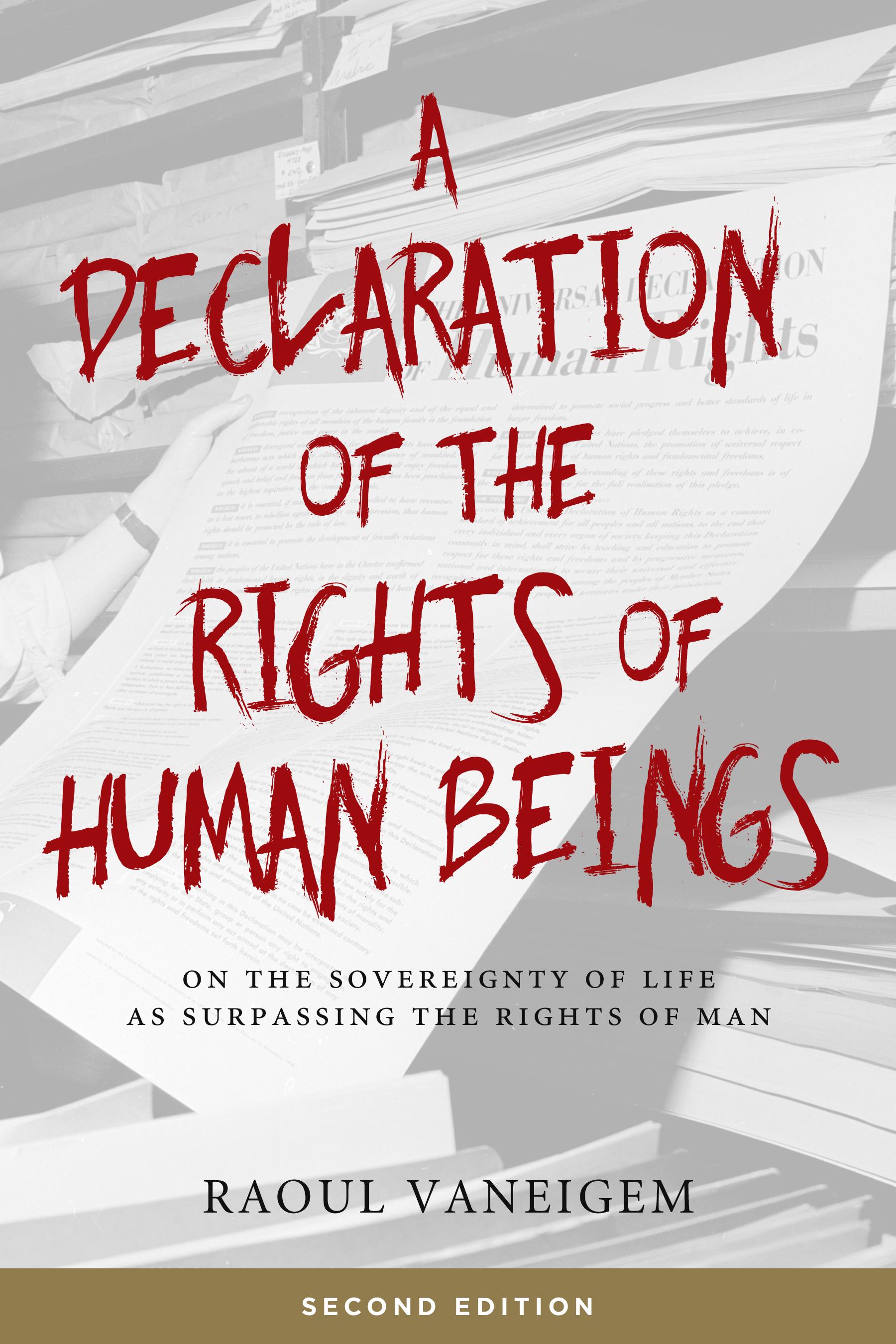
“A declaration of rights is indispensable in order to halt the ravages of despotism.” So wrote the revolutionary Antoine Barnave in support of the Declaration of the Rights of Man and of the Citizen (1789). Over two centuries after the Great French Revolution, Raoul Vaneigem writes that today, “in a situation comparable to the condition of France on the eve of its Revolution,” we cannot limit ourselves to demanding liberties—the so-called bourgeois freedoms—that came into being with free trade, for now the free exchange of capital is the totalitarian form of a system which reduces human beings and the earth itself to merchandise. The time has come to give priority to the real individual rather than to Man in the abstract, the citizen answerable to the State and to the sole dictates of God’s successor, the economy.
Sometimes playful or poetic, always provocative, Vaneigem reviews the history of bills of rights before offering his own call, with commentary, for fifty-eight rights yet to be won in a world where the “freedoms accorded to Man” are no longer merely “the freedoms accorded by man to the economy.”
Every human being has the right, for example: to become human and to be treated as such; to dispose freely of their time; to comfort and luxury; to free modes of transport set up by and for the collectivity; to permanent control over scientific experimentation; to association by affinity; to bend toward life what was turned toward death; to the flux of passions and the freedoms of love; to a natural life and a natural death; to hold nothing sacred; to excess and to moderation; to desire what seems beyond the realm of the possible.
Readers of Vaneigem’s now-classic work The Revolution of Everyday Life will find much to engage with in this unique work of subversive utopianism.
Pay easily by card, Klarna, Apple Pay or Google Pay. Not happy? You always have a 14-day money-back guarantee. Read more in our terms. If you have any questions, email us at hello@memmo.org.
Memmo makes studying easier – wherever you are in the world. We bring your course books and smart study tools together in one place: summaries, quizzes, podcasts and flashcards. Plus Ted, your study buddy who answers anything you wonder. Over 50,000 students already study here – built to help you learn faster and stress less.