
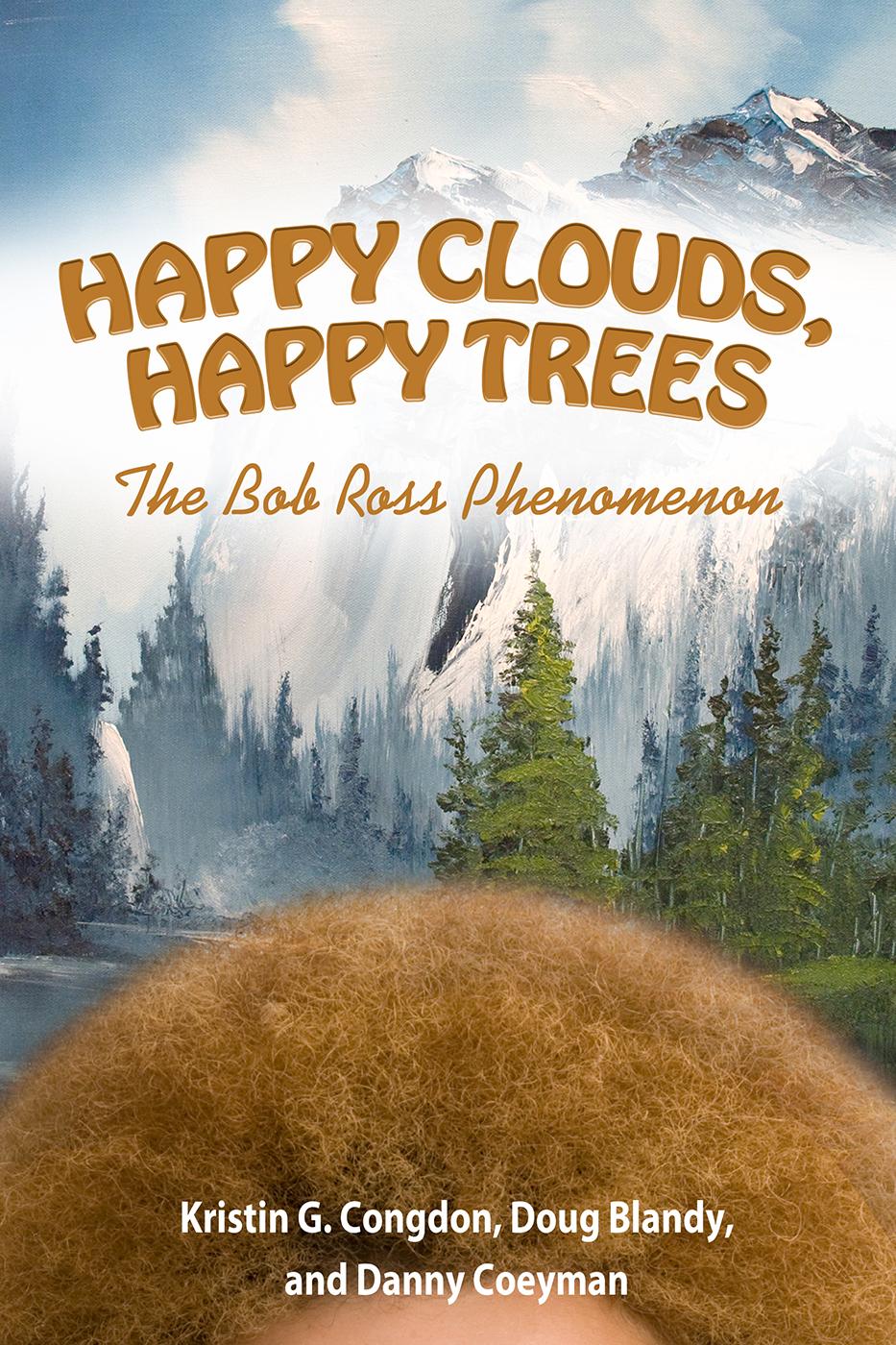
Readers will know Bob Ross (1942-1995) as the gentle, afro'd painter of happy trees on PBS. And while the Florida-born artist is reviled or ignored by the elite art world and scholarly art educators, he continues to be embraced around the globe as a healer and painter, even decades after his death. In Happy Clouds, Happy Trees, the authors thoughtfully explore how the Bob Ross phenomenon grew into a juggernaut.
Although his sincerity in embracing democracy, gift economies, conservation, and self-help may have left him previously denigrated as a subject of rigorous scholarship, this book uses contemporary art theory to explore the sophistication of Bob Ross's vision as an artist. It traces the ways in which his many fans have worshiped, emulated, and parodied him and his work. His technique allowed him to paint over 35,000 paintings in his lifetime, mostly of mountains and trees in landscapes heavily influenced by his time in the Air Force and stationed in Alaska.
The authors address issues of amateur art, sentimentality, imitation, boredom, seduction, and democratic practices in the art world. They fully examine Ross as a painter, teacher, healer, media star, performer, magician, and networker. In-depth comparisons are made to Andy Warhol and Thomas Kinkade, and mention is made of his life in relation to Joseph Beuys, Elvis Presley, St. Francis of Assisi, Carl Rogers, and many other creative personalities. In the end, Happy Clouds, Happy Trees presents Ross as a gift giver, someone who freely teaches the act of painting to anyone who believes in Ross's vision that "this is your world."
Although his sincerity in embracing democracy, gift economies, conservation, and self-help may have left him previously denigrated as a subject of rigorous scholarship, this book uses contemporary art theory to explore the sophistication of Bob Ross's vision as an artist. It traces the ways in which his many fans have worshiped, emulated, and parodied him and his work. His technique allowed him to paint over 35,000 paintings in his lifetime, mostly of mountains and trees in landscapes heavily influenced by his time in the Air Force and stationed in Alaska.
The authors address issues of amateur art, sentimentality, imitation, boredom, seduction, and democratic practices in the art world. They fully examine Ross as a painter, teacher, healer, media star, performer, magician, and networker. In-depth comparisons are made to Andy Warhol and Thomas Kinkade, and mention is made of his life in relation to Joseph Beuys, Elvis Presley, St. Francis of Assisi, Carl Rogers, and many other creative personalities. In the end, Happy Clouds, Happy Trees presents Ross as a gift giver, someone who freely teaches the act of painting to anyone who believes in Ross's vision that "this is your world."
Pay easily by card, Klarna, Apple Pay or Google Pay. Not happy? You always have a 14-day money-back guarantee. Read more in our terms. If you have any questions, email us at hello@memmo.org.
Memmo makes studying easier – wherever you are in the world. We bring your course books and smart study tools together in one place: summaries, quizzes, podcasts and flashcards. Plus Ted, your study buddy who answers anything you wonder. Over 50,000 students already study here – built to help you learn faster and stress less.
You might also like
Buy the book0