
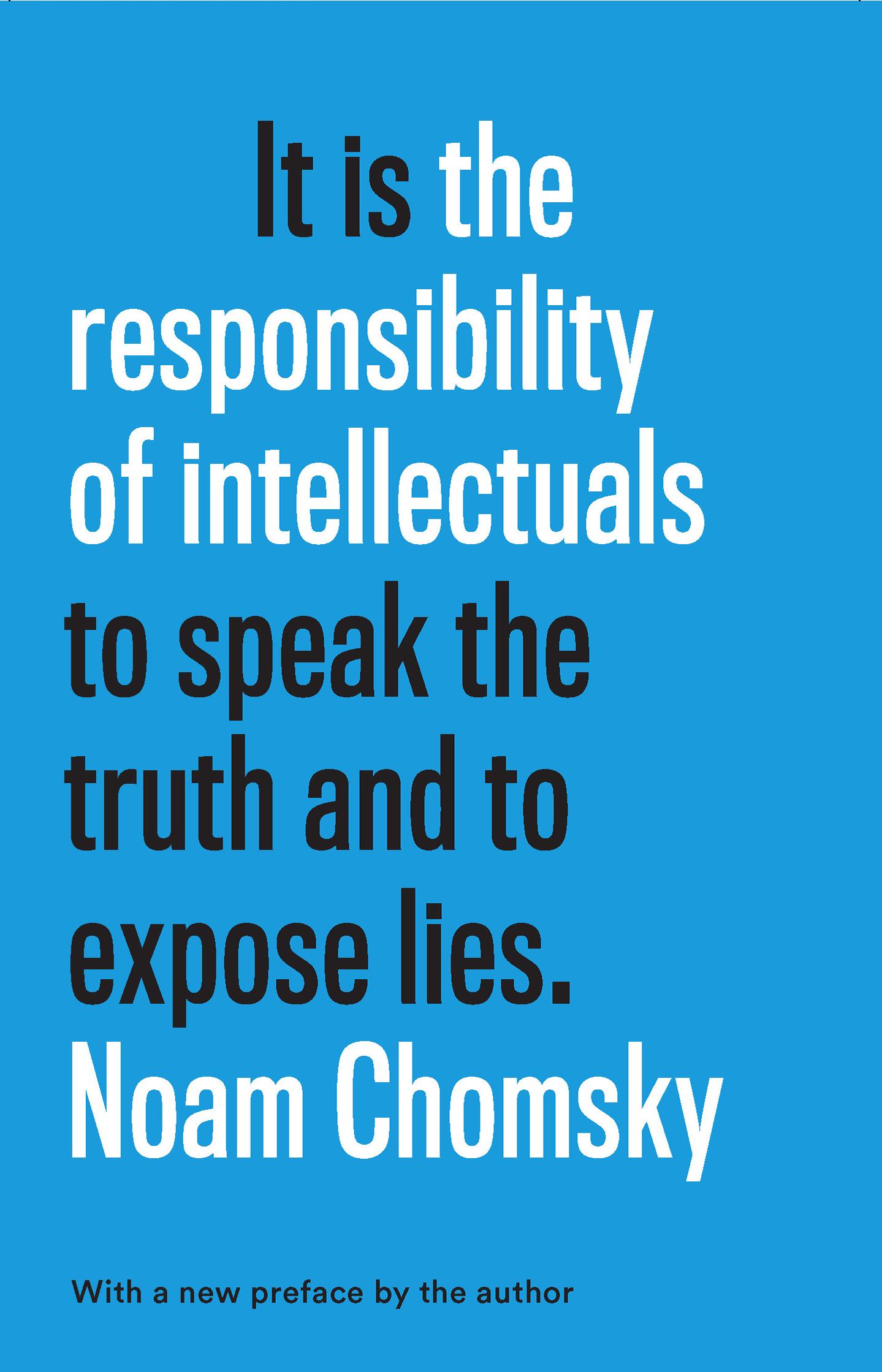
In one of his most famous essays, Noam Chomsky lays out the idea that intellectuals’ relative privilege imbues them with greater responsibility—one that was to be the guiding principle of his intellectual life
“Chomsky is a global phenomenon. . . . He may be the most widely read American voice on foreign policy on the planet.” —The New York Times Book Review
As a nineteen-year-old undergraduate in 1947, Noam Chomsky was deeply affected by articles about the responsibility of intellectuals written by Dwight Macdonald, an editor of Partisan Review and then of Politics. Twenty years later, as the Vietnam War was escalating, Chomsky turned to the question himself, noting that “intellectuals are in a position to expose the lies of governments” and to analyze their “often hidden intentions.”
Originally published in the New York Review of Books, Chomsky’s essay eviscerated the “hypocritical moralism of the past” (such as when Woodrow Wilson set out to teach Latin Americans “the art of good government”) and exposed the destructive policies in Vietnam and the role of intellectuals in justifying them.
Chomsky then turns to the “war on terror” and “enhanced interrogation” of the Bush years in “The Responsibility of Intellectuals Redux,” an essay written on the tenth anniversary of 9/11. As relevant now as it was in 1967, The Responsibility of Intellectuals reminds us that “privilege yields opportunity and opportunity confers responsibilities.”
Pay easily by card, Klarna, Apple Pay or Google Pay. Not happy? You always have a 14-day money-back guarantee. Read more in our terms. If you have any questions, email us at hello@memmo.org.
Memmo makes studying easier – wherever you are in the world. We bring your course books and smart study tools together in one place: summaries, quizzes, podcasts and flashcards. Plus Ted, your study buddy who answers anything you wonder. Over 50,000 students already study here – built to help you learn faster and stress less.