
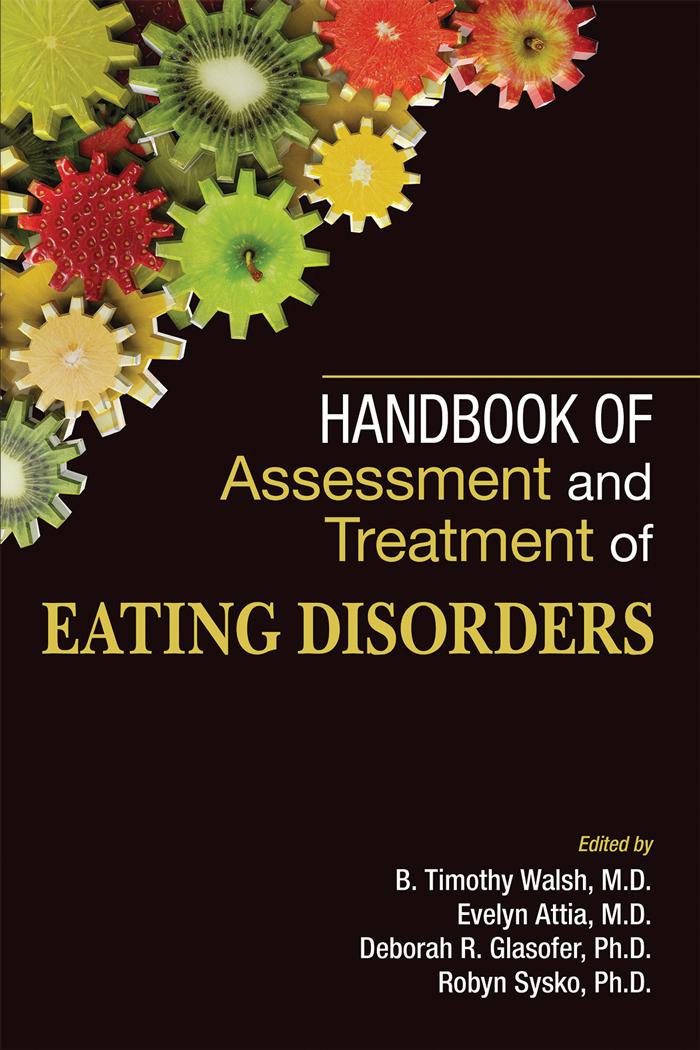
The recent publication of the revised Diagnostic and Statistical Manual of Mental Disorders (DSM-5®) has had a profound impact on the classification of eating disorders, introducing changes that were formalized after years of study by the Eating Disorders Work Group. The Handbook of Assessment and Treatment of Eating Disorders is the only book that provides clinicians with everything they need to know to implement these changes in assessment, diagnosis, and treatment. After an overview of feeding and eating disorders that systematically reviews the changes from DSM-IV to DSM-5®, some of the foremost scholars in each area address eating disorders in adults, children and adolescents, and special populations. Chapters on assessment and treatment, along with accompanying videos, offer comprehensive, state-of-the-art coverage that will benefit clinicians in practice, such as psychiatrists and psychotherapists, as well as mental health trainees.
Clinicians will find the following features and content especially useful: Five full chapters on assessment tools cover the evolution of measures and instruments, from the primitive beginnings to the cutting edge of new technological applications. The challenges of diagnosing feeding and eating disorders in children and adolescents are also addressed. Treatment chapters cover restrictive eating, including anorexia nervosa and avoidant/restrictive food intake disorder, binge eating, including bulimia nervosa and binge-eating disorder, and other eating problems, including pica, rumination disorder, and night eating syndrome. One chapter focuses on eating problems among men and boys, who have diverse presentations, and the motivations and body image disturbances that may differ from those typically found among females. Because attunement to culturally and socially patterned characteristics of clinical presentation is essential to an informed and accurate mental health assessment, an entire chapter is devoted to clinical effectiveness in multicultural and cross-cultural settings. Each chapter ends with key clinical points to help readers focus on the most salient content, test comprehension, and review for examinations.
Clinicians in both training and practice will find the book's up-to-date, DSM-5®--compatible content to be utterly essential. The Handbook of Assessment and Treatment of Eating Disorders belongs in the library of every mental health professional practicing today.
Pay easily by card, Klarna, Apple Pay or Google Pay. Not happy? You always have a 14-day money-back guarantee. Read more in our terms. If you have any questions, email us at hello@memmo.org.
Memmo makes studying easier – wherever you are in the world. We bring your course books and smart study tools together in one place: summaries, quizzes, podcasts and flashcards. Plus Ted, your study buddy who answers anything you wonder. Over 75,000 students already study here – built to help you learn faster and stress less.