
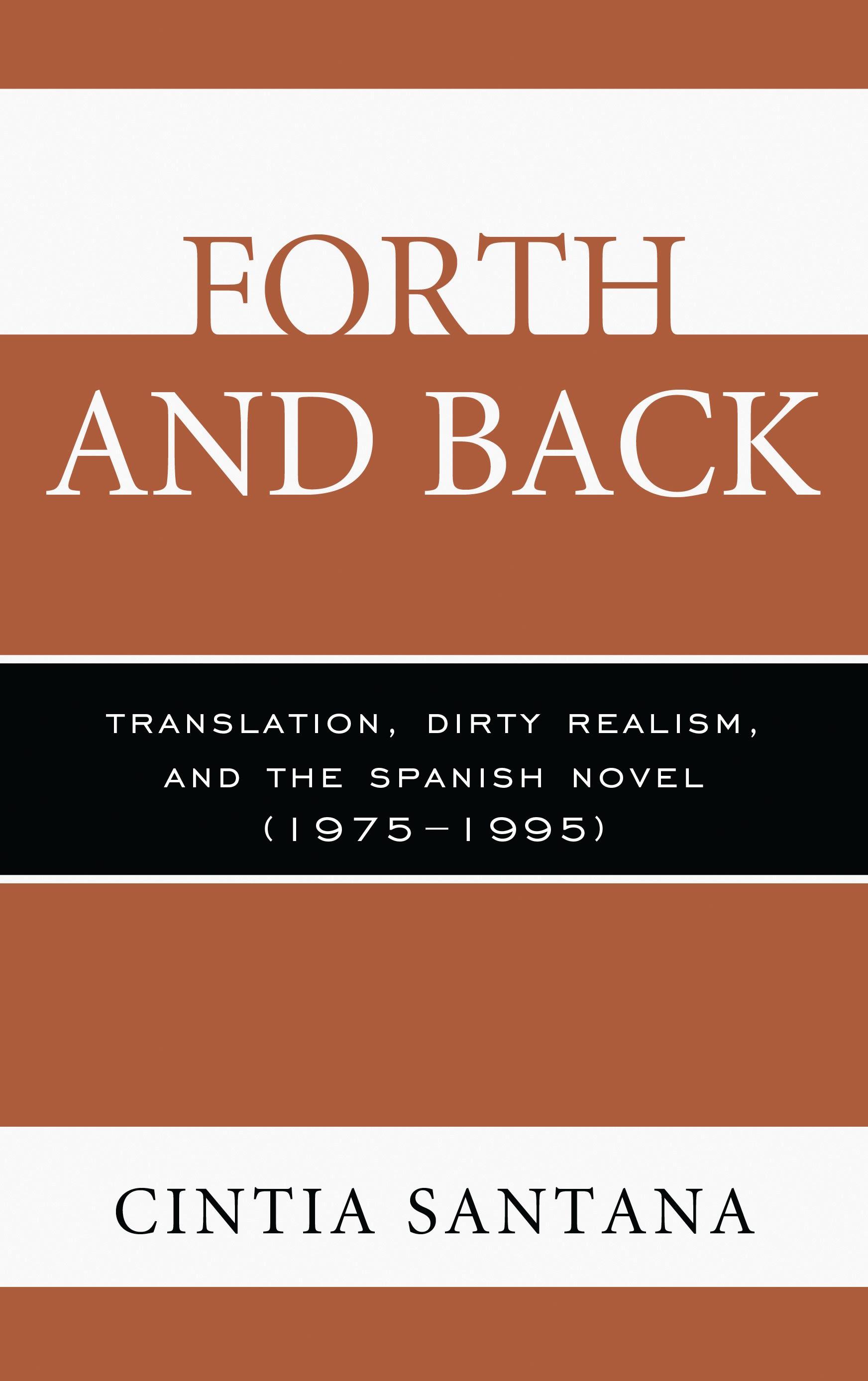
Forth and Back broadens the scope of Hispanic trans-Atlantic studies by shifting its focus to Spain’s trans-literary exchange with the United States at the end of the twentieth century. Santana analyzes the translation “boom” of U.S. literature that marked literary production in Spain after Franco’s death, and the central position that U.S. writing came to occupy within the Spanish literary system. Santana examines the economic and literary motives that underlay the phenomenon, as well as the particular socio-cultural appeal that U.S. “dirty realist” writers—which in Spain included authors as diverse as Charles Bukowski, Raymond Carver, and Bret Easton Ellis—held for Spaniards in the 1980s. Santana also studies the subsequent appropriation of this writing by a polemic group of young Spanish writers in the 1990s whoself-consciously and insistently associated themselves with the U.S..
Forth and Back illustrates that literary movements do not unilaterally spread; rather, those that flourish take root in fertile soil and are transformed in their travel by the desires, creative choices, and practical constraints of their differing producers and consumers. It is precisely in the crossing of these currents that plots thicken. The translation of dirty realism, its reception in Spain, and its cultural legacy as appropriated by the young Spanish writers, serve to interrogate a perceived U.S. hegemony. If Spanish realismo sucio has been said to be symptomatic of the globalization of literature, Forth and Back argues that the Spanish works in question posed a subtle reaffirmation of Spanish literature’s strong ties to realist fiction, a gesture of continuity in a decade that seemed to presence the undoing of much of Spain’s “Spanish-ness.” Ultimately, this project asks an ambitious pair of questions at the heart of human culture: how do we “read” each other, quite literally, across geography and language? How do we construct others and ourselves vis-à-vis those readings?
Forth and Back illustrates that literary movements do not unilaterally spread; rather, those that flourish take root in fertile soil and are transformed in their travel by the desires, creative choices, and practical constraints of their differing producers and consumers. It is precisely in the crossing of these currents that plots thicken. The translation of dirty realism, its reception in Spain, and its cultural legacy as appropriated by the young Spanish writers, serve to interrogate a perceived U.S. hegemony. If Spanish realismo sucio has been said to be symptomatic of the globalization of literature, Forth and Back argues that the Spanish works in question posed a subtle reaffirmation of Spanish literature’s strong ties to realist fiction, a gesture of continuity in a decade that seemed to presence the undoing of much of Spain’s “Spanish-ness.” Ultimately, this project asks an ambitious pair of questions at the heart of human culture: how do we “read” each other, quite literally, across geography and language? How do we construct others and ourselves vis-à-vis those readings?
Pay easily by card, Klarna, Apple Pay or Google Pay. Not happy? You always have a 14-day money-back guarantee. Read more in our terms. If you have any questions, email us at hello@memmo.org.
Memmo makes studying easier – wherever you are in the world. We bring your course books and smart study tools together in one place: summaries, quizzes, podcasts and flashcards. Plus Ted, your study buddy who answers anything you wonder. Over 50,000 students already study here – built to help you learn faster and stress less.