
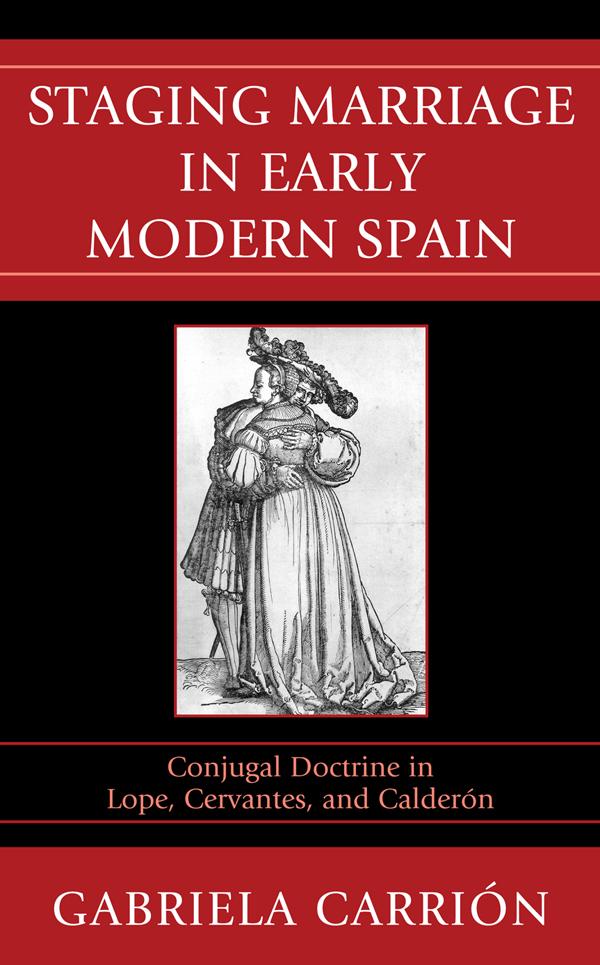
Staging Marriage in Early Modern Spain examines selected dramatic works where the vicissitudes of matrimony play center stage. Various aspects of conjugal relations including courtship, divorce, and widowhood take on particular relevance in the Spanish comedia in light of the intense debates raging over the "seventh sacrament" in early modern Europe. The institution of matrimony is subject to unprecedented scrutiny during this period and provides a rich source of material for playwrights such as Lope de Vega, Miguel de Cervantes, and Pedro Calderón de la Barca. Taking the decrees on marriage of the Council of Trent (1563) as a point of departure, Carrión examines the conjugal bond within a literary and historical framework, offering close readings of dramatic works, religious decrees, and moral treatises where the conjugal bond plays a central role. She identifies in works such as Lope's Peribáñez y el Comendador de Ocaña, Cervantes' El juez de los divorcios, and Calderón's El medico de su honra the emergence of more modern perspectives on marriage. One of the central questions this study raises is the degree to which the dramatic works of early modern Spain conform to the morality espoused by the treatises that defined marriage at the time. While the tone of prescriptive discourses contrasts with the lyrical voices of the Spanish stage, both reveal a number of inherent-and compelling-contradictions in their views of the conjugal bond.
Pay easily by card, Klarna, Apple Pay or Google Pay. Not happy? You always have a 14-day money-back guarantee. Read more in our terms. If you have any questions, email us at hello@memmo.org.
Memmo makes studying easier – wherever you are in the world. We bring your course books and smart study tools together in one place: summaries, quizzes, podcasts and flashcards. Plus Ted, your study buddy who answers anything you wonder. Over 75,000 students already study here – built to help you learn faster and stress less.