
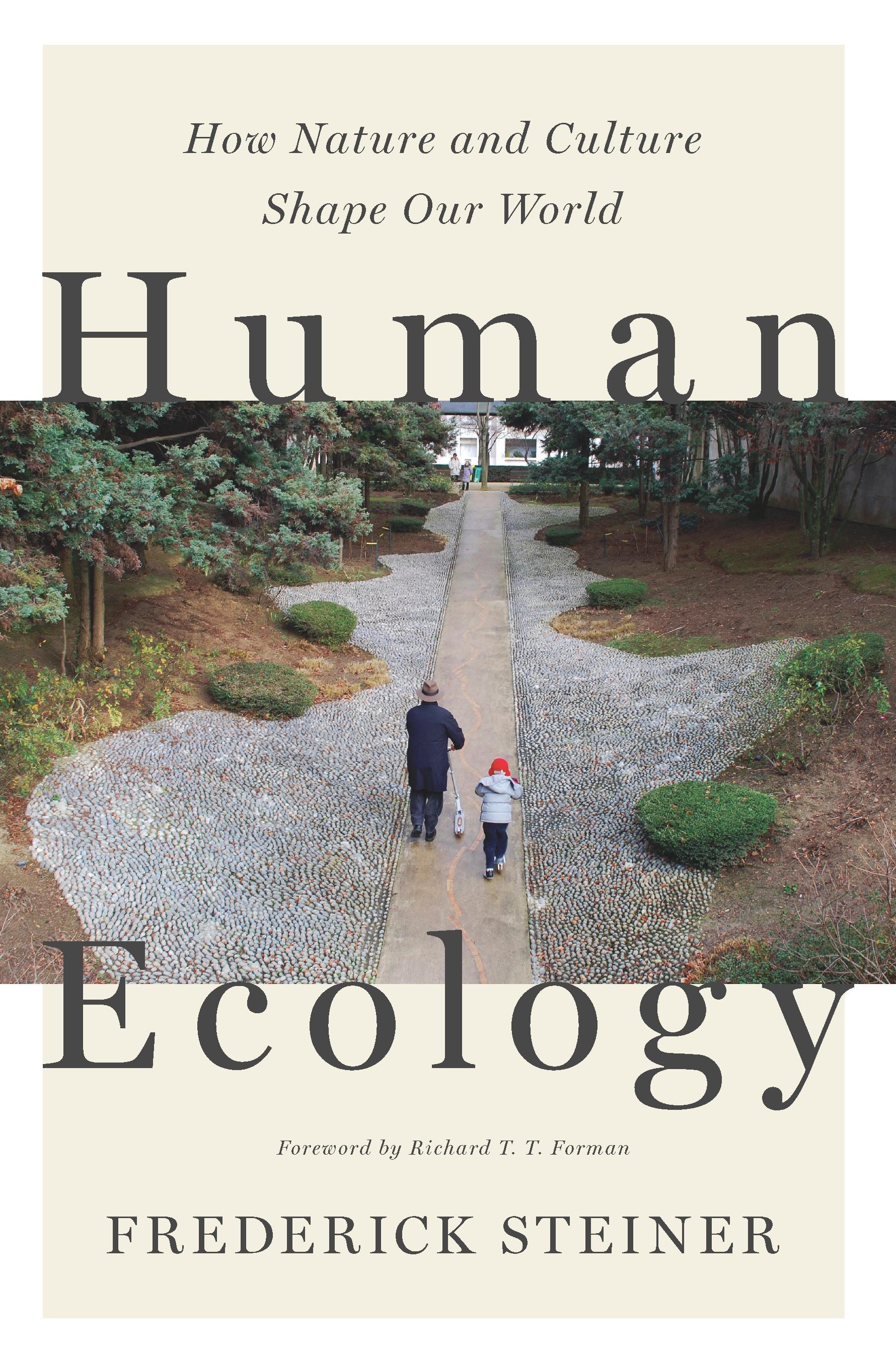
Humans have always been influenced by natural landscapes, and always will be—even as we create ever-larger cities and our developments fundamentally change the nature of the earth around us. In Human Ecology, noted city planner and landscape architect Frederick Steiner encourages us to consider how human cultures have been shaped by natural forces, and how we might use this understanding to contribute to a future where both nature and people thrive.
Human ecology is the study of the interrelationships between humans and their environment, drawing on diverse fields from biology and geography to sociology, engineering, and architecture. Steiner admirably synthesizes these perspectives through the lens of landscape architecture, a discipline that requires its practitioners to consciously connect humans and their environments. After laying out eight principles for understanding human ecology, the book’s chapters build from the smallest scale of connection—our homes—and expand to community scales, regions, nations, and, ultimately, examine global relationships between people and nature.
In this age of climate change, a new approach to planning and design is required to envision a livable future. Human Ecology provides architects, landscape architects, urban designers, and planners—and students in those fields— with timeless principles for new, creative thinking about how their work can shape a vibrant, resilient future for ourselves and our planet.
Pay easily by card, Klarna, Apple Pay or Google Pay. Not happy? You always have a 14-day money-back guarantee. Read more in our terms. If you have any questions, email us at hello@memmo.org.
Memmo makes studying easier – wherever you are in the world. We bring your course books and smart study tools together in one place: summaries, quizzes, podcasts and flashcards. Plus Ted, your study buddy who answers anything you wonder. Over 75,000 students already study here – built to help you learn faster and stress less.