
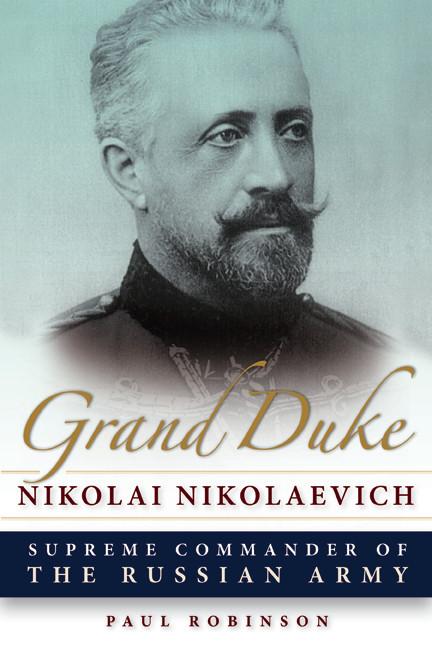
Grand Duke Nikolai Nikolaevich Romanov (1856–1929) was a key figure in late Imperial Russia, and one of its foremost soldiers. At the outbreak of World War I, his cousin, Tsar Nicholas II, appointed him Supreme Commander of the Russian Army. From 1914 to 1915, and then again briefly in 1917, he was commander of the largest army in the world in the greatest war the world had ever seen. His appointment reflected the fact that he was perhaps the man the last Emperor of Russia trusted the most. At six foot six, the Grand Duke towered over those around him. His fierce temper was a matter of legend. However, as Robinson's vivid account shows, he had a more complex personality than either his supporters or detractors believed.
In a career spanning fifty years, the Grand Duke played a vital role in transforming Russia's political system. In 1905, the Tsar assigned him the duty of coordinating defense and security planning for the entire Russian empire. When the Tsar asked him to assume the mantle of military dictator, the Grand Duke, instead of accepting, persuaded the Tsar to sign a manifesto promising political reforms. Less opportunely, he also had a role in introducing the Tsar and Tsarina to the infamous Rasputin. A few years after the revolution in 1917, the Grand Duke became de facto leader of the Russian émigré community.
Despite his importance, the only other biography of the Grand Duke was written by one of his former generals in 1930, a year after his death, and it is only available in Russian. The result of research in the archives of seven countries, this groundbreaking biography—the first to appear in English—covers the Grand Duke's entire life, examining both his private life and his professional career. Paul Robinson's engaging account will be of great value to those interested in World War I and military history, Russian history, and biographies of notable figures.
Pay easily by card, Klarna, Apple Pay or Google Pay. Not happy? You always have a 14-day money-back guarantee. Read more in our terms. If you have any questions, email us at hello@memmo.org.
Memmo makes studying easier – wherever you are in the world. We bring your course books and smart study tools together in one place: summaries, quizzes, podcasts and flashcards. Plus Ted, your study buddy who answers anything you wonder. Over 50,000 students already study here – built to help you learn faster and stress less.