
Dynamic problems require dynamic collaboration and technology.
Our communities today face difficult issues—such as climate change, access to health care, and homelessness—which are tangled, complicated, and constantly evolving. Coined “wicked problems” more than 40 years ago by the University of California’s professors Horst Rittel and C. West Churchman, these issues exceed the capacity of any one sector, instead demanding the kind of creative thinking, democratized engagement, and integrated action that come from government, nonprofits, businesses, and citizens working in concert.
These different stakeholders, however, don’t always agree on the best approach, strategy, or goals. But their commonality in driving social outcomes relies on place: where problems are happening, where people need assistance and help defining the issues. Maps combine complex and relational information that can be visualized and analyzed to deal with these issues. When used with technological developments in data analytics, visualization, connectivity, and the Internet of Things (IoT), mapping can promote effective cross-sector collaboration.
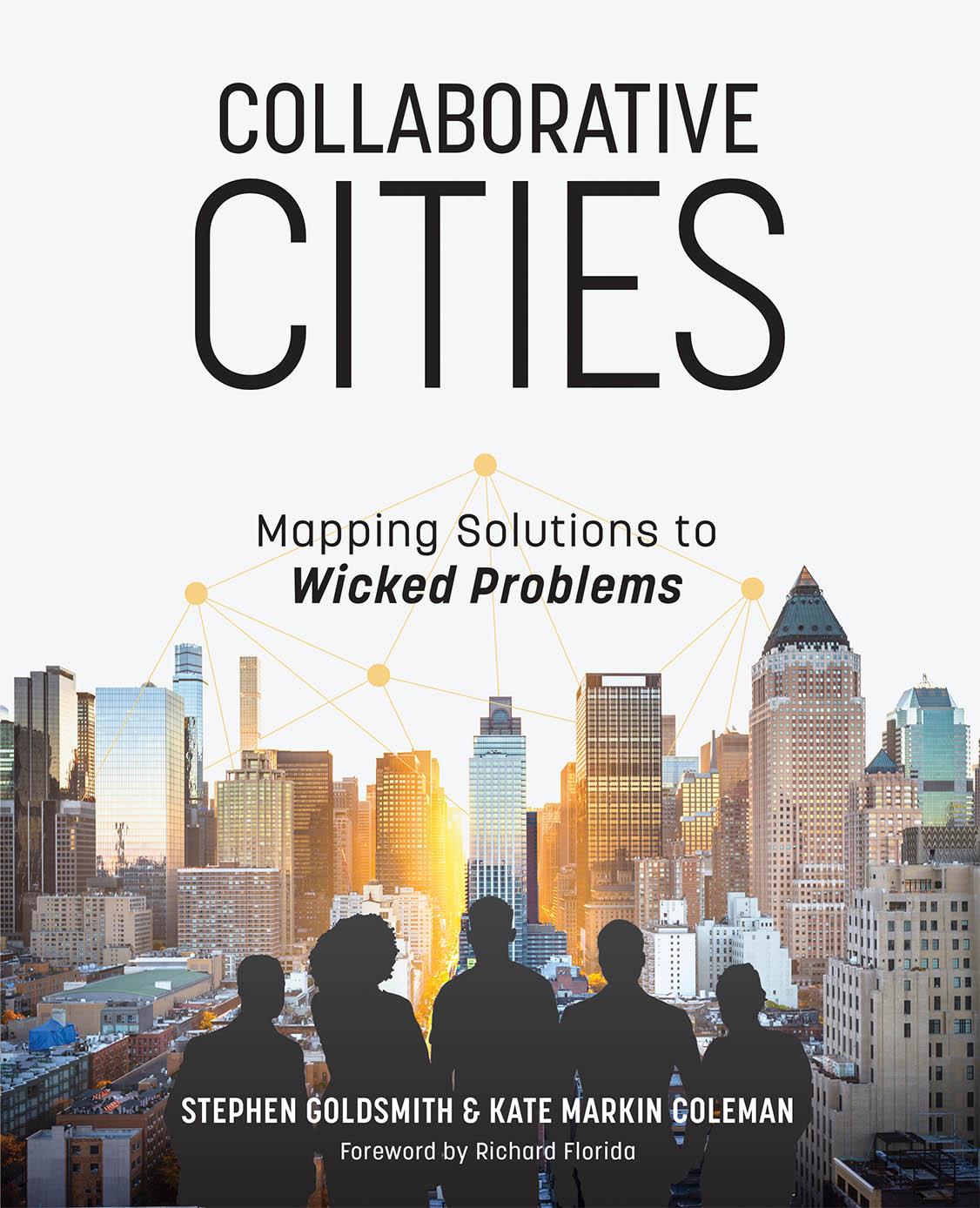
Written for citizens and city leaders, Collaborative Cities: Mapping Solutions to Wicked Problems guides readers into using location intelligence to derive public value from action. Co-authors Stephen Goldsmith (former mayor of Indianapolis and deputy mayor of New York) and Kate Markin Coleman (former executive vice president for branding and strategy at the YMCA) use their combined years of experience to analyze the best civic examples of geospatial technology working across cross-sector networks. Divided into eight chapters, Collaborative Cities addresses the formation, operation, and adaptation of cross-sector collaborations, including five chapters dedicated to specific wicked problems such as public safety, homelessness, and sustainability.
Starting with Collaborative Cities, government officials, nonprofit leaders, and citizens alike who are acting for social value can learn how to use a geospatial approach to improve insight, trust, and the efficacy of their combined efforts to solve wicked problems.
Pay easily by card, Klarna, Apple Pay or Google Pay. Not happy? You always have a 14-day money-back guarantee. Read more in our terms. If you have any questions, email us at hello@memmo.org.
Memmo makes studying easier – wherever you are in the world. We bring your course books and smart study tools together in one place: summaries, quizzes, podcasts and flashcards. Plus Ted, your study buddy who answers anything you wonder. Over 75,000 students already study here – built to help you learn faster and stress less.