
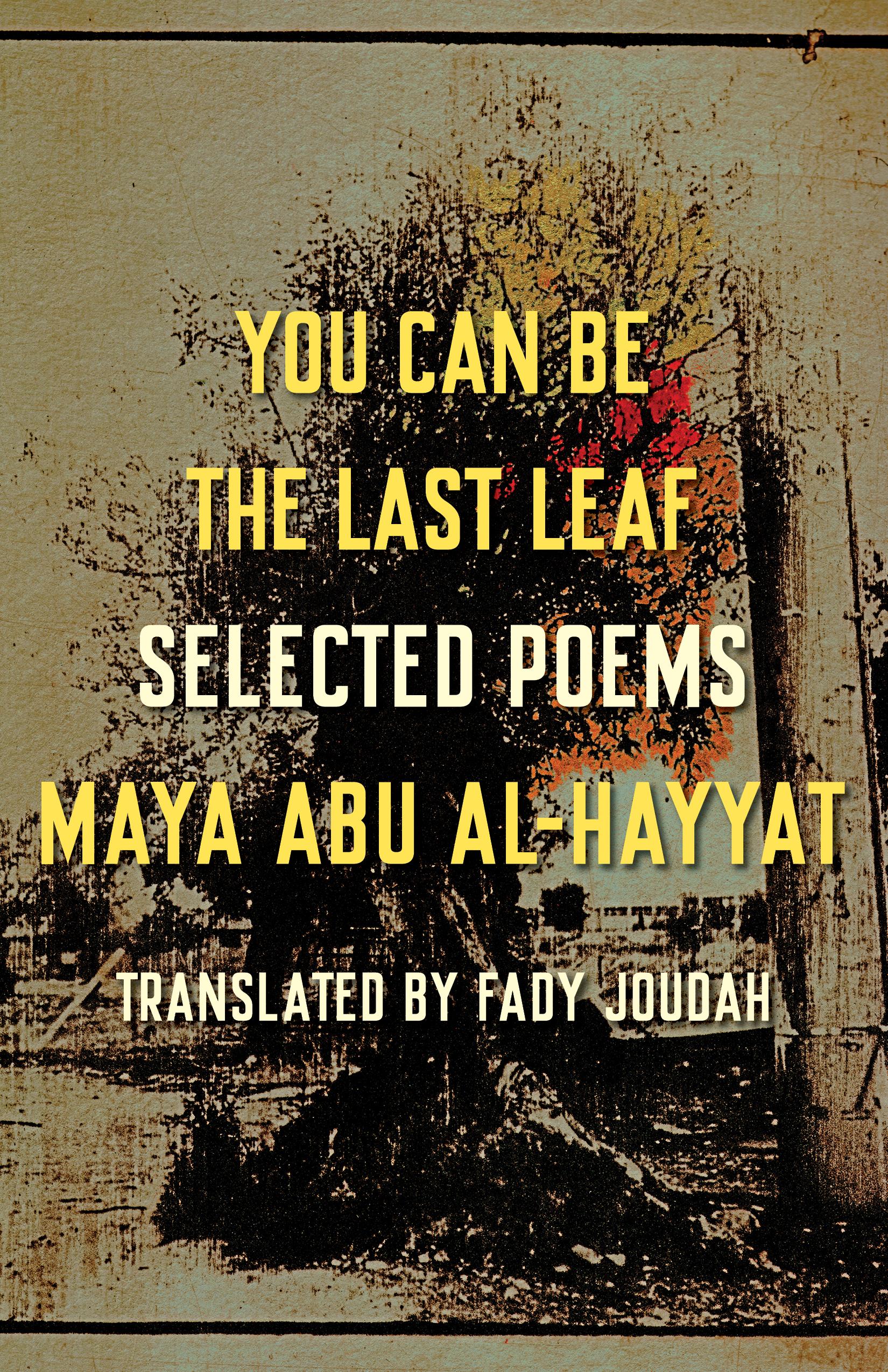
Translated from the Arabic and introduced by Fady Joudah, You Can Be the Last Leaf draws on two decades of work to present the transcendent and timely US debut of Palestinian poet Maya Abu Al-Hayyat.
Art. Garlic. Taxis. Sleepy soldiers at checkpoints. The smell of trash on a winter street, before “our wild rosebush, neglected / by the gate, / blooms.” Lovers who don’t return, the possibility that you yourself might not return. Making beds. Cleaning up vomit. Reading recipes. In You Can Be the Last Leaf, these are the ordinary and profound—sometimes tragic, sometimes dreamy, sometimes almost frivolous—moments of life under Israeli occupation.
Here, private and public domains are inseparable. Desire, loss, and violence permeate the walls of the home, the borders of the mind. And yet that mind is full of its own fierce and funny voice, its own preoccupations and strangenesses. “It matters to me,” writes Abu Al-Hayyat, “what you’re thinking now / as you coerce your kids to sleep / in the middle of shelling”: whether it’s coming up with “plans / to solve the world’s problems,” plans that “eliminate longing from stories, remove exhaustion from groans,” or dreaming “of a war / that’s got no war in it,” or proclaiming that “I don’t believe in survival.”
In You Can Be the Last Leaf, Abu Al-Hayyat has created a richly textured portrait of Palestinian interiority—at once wry and romantic, worried and tenacious, and always singing itself.
Art. Garlic. Taxis. Sleepy soldiers at checkpoints. The smell of trash on a winter street, before “our wild rosebush, neglected / by the gate, / blooms.” Lovers who don’t return, the possibility that you yourself might not return. Making beds. Cleaning up vomit. Reading recipes. In You Can Be the Last Leaf, these are the ordinary and profound—sometimes tragic, sometimes dreamy, sometimes almost frivolous—moments of life under Israeli occupation.
Here, private and public domains are inseparable. Desire, loss, and violence permeate the walls of the home, the borders of the mind. And yet that mind is full of its own fierce and funny voice, its own preoccupations and strangenesses. “It matters to me,” writes Abu Al-Hayyat, “what you’re thinking now / as you coerce your kids to sleep / in the middle of shelling”: whether it’s coming up with “plans / to solve the world’s problems,” plans that “eliminate longing from stories, remove exhaustion from groans,” or dreaming “of a war / that’s got no war in it,” or proclaiming that “I don’t believe in survival.”
In You Can Be the Last Leaf, Abu Al-Hayyat has created a richly textured portrait of Palestinian interiority—at once wry and romantic, worried and tenacious, and always singing itself.
Pay easily by card, Klarna, Apple Pay or Google Pay. Not happy? You always have a 14-day money-back guarantee. Read more in our terms. If you have any questions, email us at hello@memmo.org.
Memmo makes studying easier – wherever you are in the world. We bring your course books and smart study tools together in one place: summaries, quizzes, podcasts and flashcards. Plus Ted, your study buddy who answers anything you wonder. Over 50,000 students already study here – built to help you learn faster and stress less.
You might also like
Buy the book0