
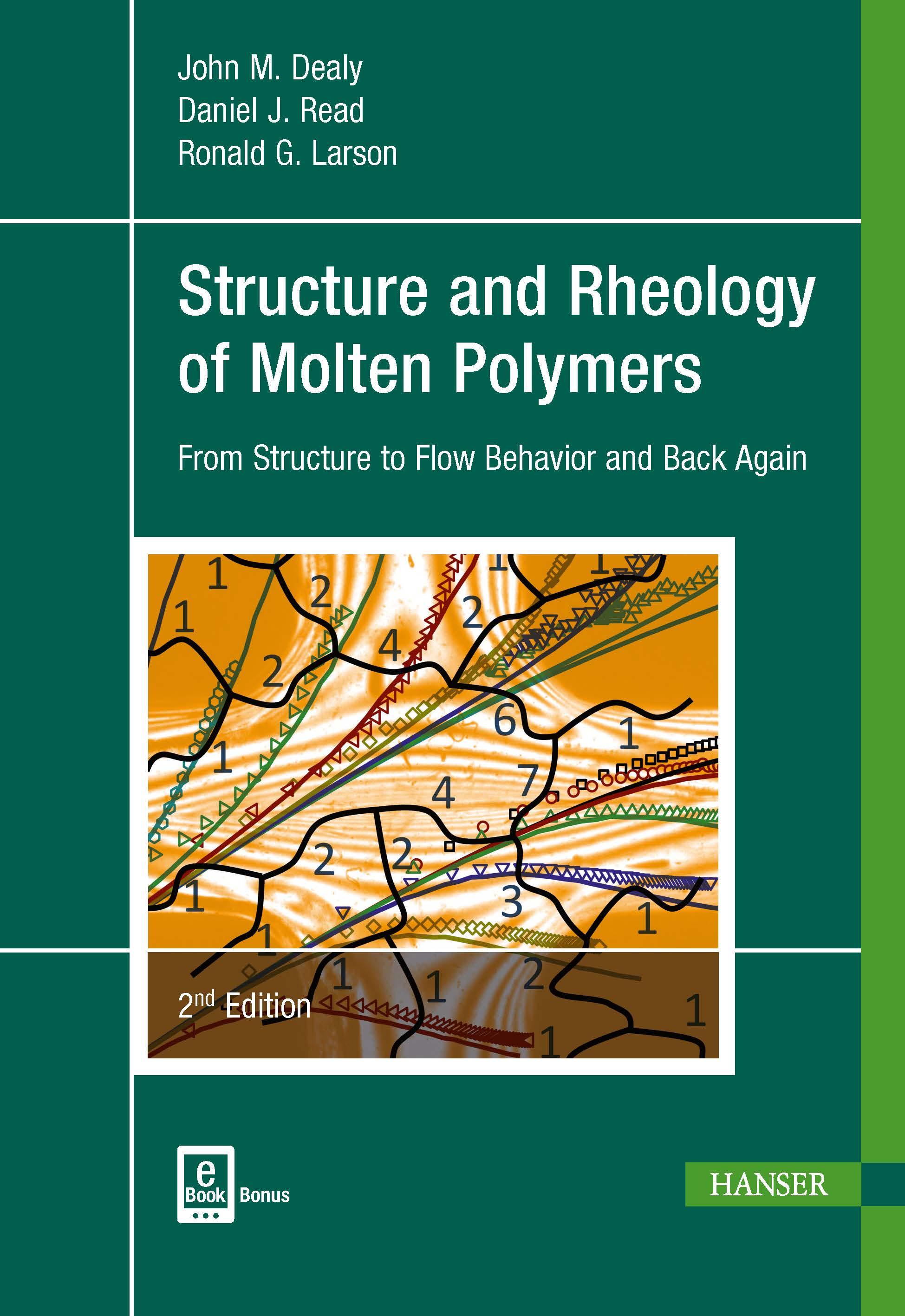
Recent advances in polymer science have made it possible to relate quantitatively molecular structure to rheological behavior. At the same time, new methods of synthesis and characterization allow the preparation and structural verification of samples having a range of branched polymeric structures. This book unites this knowledge to enable production of polymers with prescribed processability and end-product properties.
Methods of polymer synthesis and characterization are described, starting from fundamentals. The foundations of linear viscoelasticity are introduced, and then the linear behavior of entangled polymers is described in detail. This is followed by a discussion of the molecular modeling of linear behavior. Tube models for both linear and branched polymers are presented. The final two chapters deal with nonlinear rheological behavior and tube models to describe nonlinearity.
In this second edition, each chapter has been significantly rewritten to account for recent advances in experimental methods and theoretical modeling. It includes new and updated material on developments in polymer synthesis and characterization, computational algorithms for linear and nonlinear rheology prediction, measurement of nonlinear viscoelasticity, entanglement detection algorithms in molecular dynamics, nonlinear constitutive equations, and instabilities.
Pay easily by card, Klarna, Apple Pay or Google Pay. Not happy? You always have a 14-day money-back guarantee. Read more in our terms. If you have any questions, email us at hello@memmo.org.
Memmo makes studying easier – wherever you are in the world. We bring your course books and smart study tools together in one place: summaries, quizzes, podcasts and flashcards. Plus Ted, your study buddy who answers anything you wonder. Over 50,000 students already study here – built to help you learn faster and stress less.
You might also like
Buy the book0